
Last update: December 1, 2023
This was the very first site on the Internet about saving electricity, launching in 1999. I was telling you about LED lights, front-loading washers, and heat pump heating years before they started to become mainstream. I don't have time to update the site much these days, but most of the old info is still true today. In fact, the site is better than most articles about saving electricity in the popular press, which don't include useful numbers or which get their facts completely wrong.
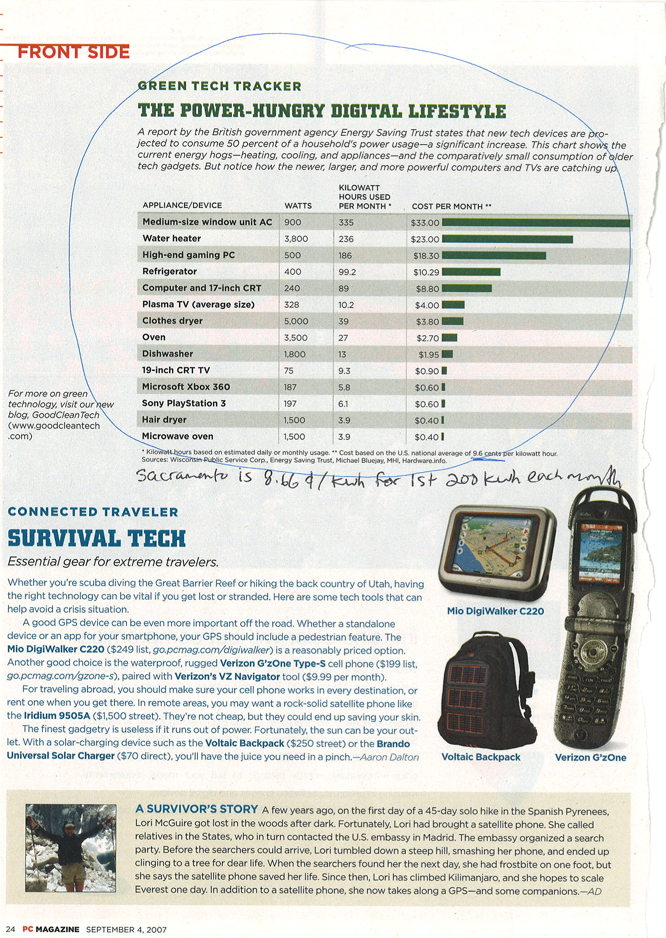
Start with learning exactly what a kilowatt hour is and how much you pay for one. You can then see how to calculate exactly how much electricity your household appliances use, so you know which items are guzzling the most juice (and which ones are the best targets for savings). You'll also learn exactly how to read your electric meter, if you like. (Find that on any other website.) Finally, I've answered countless questions from readers about saving electricity. If you have a question, it's probably answered here already.
Saving electricity doesn't just save money, it also saves energy, which means less pollution. This might be surprising, because you don't see or smell any pollution when you turn on the lights, unlike when you fire up your car. But the pollution is thereit just happens at the power plant instead of on-site. Most electricity is generated by burning coal and other fossil fuels. Every time you turn on the lights, you create a little pollution. (See the sidebar.) In fact, the average home pollutes more than the average car! (See my Carbon Footprint Calculator for the numbers.) So saving electricity doesn't just put money in your pocket, it helps keep the air and water clean, too.
Saving electricity is the low-hanging fruit. The legendary James Hansen, one of the first scientists to warn about global warming way back in the 80s, said that the real key to preventing climate change is reducing home energy use. That's because, as he says, we can't stop the oil from being burned for transport, since if we don't use it, another country will. But we can certainly stop burning our own country's coal. And the quickest way to reduce coal emissions is to reduce our electricity consumption. (more on climate change)
And if you really want to lessen your carbon footprint, you'll also want to look into eating less meat and driving less.
I hope you find this website useful. Happy savings!
— Michael Bluejay, "Mr. Electricity"
Lesson #1:
Attack the biggest energy-users first
Before we get to the tips on specific appliances, remember one simple thing: You'll save more electricity by dealing with the biggest electricity-guzzlers rather than worrying about items that don't use much electricity.
Obsessing about whether it's better to boil a cup of water on an electric burner or in a microwave, or whether you wear out your lights quicker by turning them off rather than keeping them on, is a waste of time and misses the point. Such trivia won't make a big difference in your electric bill. It's the bigger things that matter. With that in mind, you'll first want to address the big energy users in your home first, such as your:
- Heating
- Air Conditioning
- Lighting
- Clothes Washer
- Clothes Dryer
- Refrigerator (if it was made before 2001)
- Water Heater
Here are some sample savings you might be able to enjoy:
| Easy Strategies | ||
|
Strategy |
Up front cost | Potential Savings per year |
| (1) Avoid using energy-hungry appliances during peak hours. (Some utilities charge more for electricity during certain hours. Check your local rates.) (Appliances that use lots of energy are air conditioning, heating, ovens/stoves, laundry, and dishwashers.) | $0 | $1200 |
| (2) For homes with central electric heat, use space heaters to heat only the rooms you're in, and turn off the heat when you're not home. | $80 | $1116 |
| (3) Use ceiling fans instead of the air conditioner | $100 | $438 |
| (4) Use a clothesline or a laundry rack instead of a dryer | $20 | $196 |
| (5) Wash laundry in cold water instead of hot or warm | none | $152 |
| (6) Turn off six LED light bulbs (16W / 100-watt equivalent) from running constantly | $0 | $131 |
| Total | $200 once |
$3233 every year |
| Aggressive Strategies | ||
| (7) Replace top-loading washer with front-loading washer | $500 | $99 |
| (8) Replace 1992 fridge with newer, Energy Star model | $440 |
$75 |
| (9) Install mini-split heat pump AC/heat when building a new home, or replacing an existing HVAC | $0 (see note 8) |
$900 |
| Total | $940 once |
$1074 every year |
|
Assumptions: (Calculations are always only as
good as the assumptions. See how
to misquote this website.) Retired strategies: |
||
»» Next: How much electricity costs »»
This chart shows where the U.S. gets its electricity. Note that
most of it was from burning coal. (Source: Department
of Energy)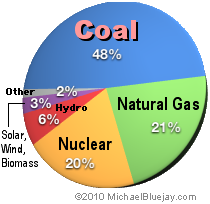
How much pollution?
Here's a calculator which will show you how
much pollution is created from your electrical use. The
typical home accounts for more pollution than the typical car. (source)
More on energy production
On a separate page we have info about how
much fuel is required to produce electricity.
Fan mail & success stories
If I could bookmark only one energy website, it would be this one! Jenny Nazak, author of Deep Green
I'm just dropping a quick note to thank your for your amazing electricity subsite. It's outstanding. I've been working to improve my finances for a while, and every little bit helps. I just posted about your Saving Electricity site on my site (Get Rich Slowly). I hope to steer others to the information you've provided. -- J.D. Roth, Get Rich Slowly I love your site, I have cut my oil bill in half by using space heaters which has really saved me money as a direct result of your advice. - Andrew G.
We took a lot of advice from your web site last month. Got
electric bill today. 30 days later & we have a $100 savings!
the weather has been MUCH colder this month than last. THANK
YOU! - Eileen Phillips &
Cheryl Myers, Blackstone, VA
I studied your site after deciding that I was determined to put an end to paying for (and wasting) lots of electricity. I bought a kilowatt meter to measure my usage. In the first month I dropped my from 578 kWh avg. to 197 kWh. This past month after replacing my 1980's fridge with a new one I was able to get down to 150 kilowatt-hours, and that includes my home office. My electric company lets you look at and compare the past 14 months worth of usage and bills online. I saved $50 this past month compared to last year and plan on saving more than $1000 for the year over 2004. Our rates are about 14 cents for delivery and usage not including the $7.36 customer charge, so this has made a big impact. So I just wanted express a quick 'thank you' for your site. I appreciate the depth of information and the ability to reference many other sites. best regards, Aaron Patt Thank you for making 'Saving Electricity.' I googled for a site about using the window units in my apartment more efficiently (I'm used to central air) and after reading your site I've gone from running two window units and a fan on high and still being uncomfortably warm to sitting directly in front of a single fan, on low, and I'm a little chilly. I think I'm also going to purchase clothes drying rack. I have a wacky idea about trying to use my fan and hanging my clothes up to dry in conjunction.... —Veronica Pare
What an AMAZING web site! How grateful I am that you were kind enough to share your vast knowledge on saving electricity. I can certainly understand why you are no longer taking any more questions. You've written the definitive guide to all things electric. That anyone could take offense or consider you less than reasonable for retiring on the subject is unbelievable. Those of us who are concerned about the environment - and "living below our means" - salute you. Thank you for your generosity! -- David Davis
Great web site. Thank you for you sharing your
knowledge. (Saved me from the surge
suppression scam.) —
Liz McLean
Troubleshooting
Home Electricity
The Circuit Detective is an electrician with practical
tips about how
to troubleshoot home electrical problems.