
Mr. Electricity is your guide to saving energy in your home.
Rebates & Tax Credits
for U.S. consumers
Rebates. For buying energy-efficient appliances like refrigerators, washing machines, and air conditioners.
Tax Credits. For installing things like high-efficiency water heaters, air conditioners, heaters, roofing, insulation, doors & windows, solar panels, etc.
We're recommended by the government of Berks County, PA.
Related sites:
Watt Watt. News about efficiency and conservation, written by readers of the site.
Home Power Magazine. All about renewable energy for the home.
No-Impact Man. Blog about a family striving to have no net impact. (i.e., What little they use, they offset.) Inspirational.
Off-Grid. News and resources about living without being connected to a utility company.
Ask Mr. Electricity in the news:
Cold, hard cash, Kansas City Star, June
22, 10
Stretch your dollar, not your budget, Globe
and Mail, May 18, 10
Energy-saving schemes yield ¤5.8m in savings, Times
of Malta, Dec. 20, 09
Four ways to reduce your PC's carbon footprint, CNET,
Dec 2, 09
Enjoy the mild weather, low electricity bills, Detroit
Free Press, Jul 18, 09
The most energy-efficient way to heat a cup of water,
Christian Science Monitor, Jun 16, 09
Ten ways to save energy, Times of Malta,
Jan 3, 09
Measuring your green IT baseline, InfoWorld,
Sep 4, 08
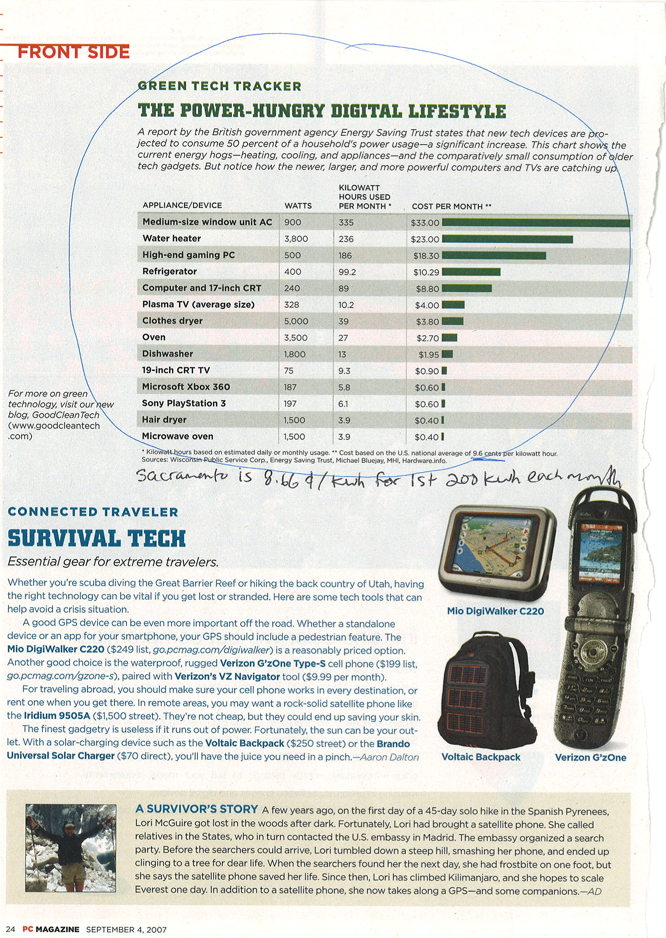
The Power Hungry Digital Lifestyle
(PDF), PC Magazine, Sep 4, 07
Net
Interest, Newsweek, Feb 12, 07
Going Green, Monsters and Critics, Jan 6,
2007
A hunt for energy hogs, Wall Street Journal
Online, Dec 18 06
|
If you like this site, you might also like some of my
other sites:
[an error occurred while processing this directive]
[an error occurred while processing this directive]
[an error occurred while processing this directive]
[an error occurred while processing this directive]
[an error occurred while processing this directive]
[an error occurred while processing this directive]
[an error occurred while processing this directive]
|
|
How to save
money on heating
costs
There are four main
strategies to save money on
heat:
- Heat only
the parts of your home that you're
using. Heating your whole
house is more expensive than heating
just part of it. Don't close registers
in unused rooms, though, because you
can damage you ducts or even the
furnace itself. Instead, use space
heaters or other forms of radiant
heat in the rooms that you actually
use. (See space
heater safety.)
- Adjust
your living environment so that you're
comfortable at lower
temperatures. This includes
using ceiling fans (yes, fans, even in
winter; I'll explain below) and putting
rugs on bare floors.
- Use cheap
or efficient heating
systems. This is where we'll
choose between heat pumps vs. oil/gas,
and radiant vs. forced-air. It's a big
topic so we'll cover in detail below,
but here's a summary:
- For whole-house (forced air)
systems, heat pumps are the
cheapest to operate, but they're the
most expensive to install. They're
also safer and healthier than
oil/gas systems, which are more
likely to burn your house down and
which can poison you with the
byproducts of combustion.
(EPA)
We'll cover air- & ground-based
heat pumps in more detail
below.
- Gas or oil-based are the cheapest to install, and are
also the most common type of systems,
but they're more dangerous and
potentially unhealthy.
- Central systems are more
expensive than space heaters
or radiant heaters which heat
only specific rooms or areas. I use
one electric space heater in
whatever room I'm in, rather than
trying to heat my whole house.
- Insulate
your home well to keep heat from
escaping out of the house.
You want to pay only to heat
your home, not Wisconsin. This includes
things like weather stripping doors and
windows and putting plastic sheets over
windows.
Let's look at each of these
individually.
Heat
only the parts of your home that you're
using
aka,
Room-by-Room Heating
(Radiant Heat) instead of
Whole-House Heating
(Forced-Air)
Heating the whole house is more
expensive than heating just the room(s)
you're using. If you can heat just the
areas you're using, you should do so,
because you'll save energy and money. This
is what I use in my own home. If you
already have a whole-house system
(forced-air), this means pretending you
don't have such a system and not using it
at all. You can't just use the central
heat and close the registers in unused
rooms because that can damage your ducts
and your furnace.
Heating individual areas means using
a form of
Radiant
Heat. Radiant Heat
involves heating an object, which then
radiates the heat throughout the room.
There are many ways to get radiant heat,
such as space heaters, radiators, and
electric heating panels. Radiant is
cheaper than forced air systems for three
reasons:
- Most radiant setups give you a
choice of how much of your home you
want to heat. With forced-air you
have to heat your whole home, whether
you're using all of it or not.
- Radiant heating conveys heat
better than hot air. It allows you
to feel warmer even at a lower room
temperature.
- Personal radiant heaters (like
electric slippers and butt-warmers)
make you more comfortable at a lower
room temperature.
Here's an example to explain the
difference between radiant heat and forced
air: A toaster uses radiant heat. The
metal elements in the toaster heat up, and
convey that heat to the bread. Very
efficient. But a hot-air popcorn popper
uses forced air instead, by sucking in
room air and then blowing out hot air.
They both use similar amounts of
electricity, but the toaster is more
efficient. You could toast a piece of
bread with a popcorn popper, but it would
take longer.
Radiant Heat can be fueled by either
gas or electricity. Electricity is
more expensive, but safer and healthier.
(You're less likely to accidentally burn
your house down, and you'll never be
breathing the toxic byproducts of
combustion.)
Another advantage of radiant systems
over forced air is that the temperature is
more uniform throughout the living
area. With forced air systems the
ceiling winds up retaining most of the
warmth and the floors are pretty cold.
More information about the benefits of
radiant heat is available at WarmZone
and Anderson
Radiant Heating, although it's a
little biased since it's published by
companies who install radiant heating
systems.
There
are many kinds of radiant heat
systems:
A
electric-element unit you plug into the
wall. These
usually have a round face and oscillate
(move from side to side like a fan).
They typically use 1500 watts on the
highest setting. Most electric space
heaters are around 1500 watts, such as
this
one from Sears, which I own myself.
An
oil-filled unit you plug into the
wall. These use
electricity to heat the oil inside.
They use about the same amount of
electricity as electric-element units.
One model I found is adjustable between
600-1500 watts.
Radiant
Heat Panel. The
flat panel secures to a ceiling or wall
and plugs into an electrical outlet (or
it can be hard-wired in to the house's
electrical system). Electricity heats
metal elements inside the panel. The
panels range in size from 1'x2' to
4'x8', and energy consumption ranges
from 100 watts to 3000 watts.
Manufacturers include Thermal
Inc. and SSHC.
A related option is radiant
ceiling film.
Hydronic
Radiator. These
circulate warm water, whose heat is
then radiated into the room.
Hydronic
Floor System.
Water is heated by gas, oil,
or electricity, and then circulated
through plastic tubing which runs under
the floor or along the walls or
ceiling. If on the walls or ceiling,
the tubing may be concealed by plastic
or metal panels. These are most
efficient if they're in the floor,
because warmth rises, and because
keeping your feet warm makes you feel
warmer overall. An electric-fueled
system can easily use 1000-3000 watts
to heat a small efficiency
apartment.
Electric
Floor System. Same as
above, but the warmth comes from
low-voltage electrical wires, not piped
water.
Ceiling
Fan Heaters. A new
product on the market is the Reiker
Ceiling Fan Heater, which is a
ceiling fan that generates heat and
then blows it around the room. I
installed a couple of these in a very
small, drafty rental house and the
tenants tell me the units don't make
the place toasty on very cold days, but
that they definitely help.
Unfortunately the tenants can't compare
them to other heating methods since
they've never had any other kind of
heat in that house. In any event, this
would only be a good alternative to an
electric space heater. Remember that
electric is more expensive than gas,
whether your heating source is radiant
or not. They're suitable only as
replacements for electric space
heaters or electric-based forced
air systems, or where there's not
already a heating method installed, or
where the objective is to avoid the
hazards of combustion rather than to
save on operating costs.
Personal
Radiant Heaters. These
are great because they use just a small
amount of electricity but make you feel
much warmer, so you can spend less
money heating your whole house. These
products originated in Japan, which
isn't surprising because the Japanese
are a lot more energy-conscious than
Americans. From my friend's apartment
in Osaka I can walk to a department
store three minutes away and select
from a huge number of "hot carpet"
products, as the Japanese call them.
These range from small butt-warmer pads
up to full-room pieces. My friend has
been using one for ten years.
(Incidentally, last month the four of
us here in the apartment used only 220
kWh/mo., compared to the U.S. average
of 920. This was before winter, but we
still expect to use less than average
in winter.)
At right are pictures of hot carpets
I bought in Japan, along with an
envelope for scale. I have no idea
where to get them in the States, so if
you know of a source please let
me know. Below is another
interesting product, USB-powered
slippers. I did find a U.S.
store that sells the slippers.
Adjusting
your living
environment
Use ceiling fans
Yes, ceiling fans can actually
make you warmer. Let's see why.
In the summer, when the fan is on a
high speed, the fan blows air past you,
removing the hot air that surrounds
your body, making you feel cooler. In
the winter, you simply put the fan on
the lowest speed. That's usually not
fast enough for the air to blow past
you and make you cooler, but it's fast
enough to push down the warm air that
collects near the ceiling. (Remember,
hot air rises.) So the key is: fast
speed for summer, slow speed for
winter.
You can also try to use the switch
on the fan that changes its direction.
You can have the fan blow UP in the
winter, which will push the warm air
off the ceiling and bounce it back
towards the floor along the walls,
without rushing it past you to make you
feel cooler. And if you don't have
ceiling fans, you can simply aim a
standalone fan towards the ceiling and
get the same result. Fans of any type
use very little electricity.
So how do you know which direction
blows up and which blows down? For 90%
of fans, when you're standing under the
fan looking up, counter-clockwise blows
down and clockwise blows up. So how can
you tell whether your fan is standard
or not? Just stand under the fan with
the fan at its highest setting. If you
can feel the wind hitting you hard,
then it's blowing down. To verify, stop
the fan, change the direction, then
turn the fan on full-blast again and
compare the difference.
Here's how you change the direction:
Most fans have an up/down or left/right
switch on the side of the fan (between
the light and the fan blades), and it's
usually unlabeled. Make sure the fan is
off (not spinning) before you flip the
switch or you can damage the motor.
(Once you've turned the fan off, it's
fine to physically stop the blades with
your hand, just be gentle so you don't
bend the blades, otherwise the fan will
wobble when you turn it back on.) After
turning the fan off, flip the direction
(summer/winter) switch, then turn the
fan back on.
Using ceiling fans is one of the most
important things you can do. They use
very little electricity and make a BIG
difference in your comfort level. All
ceiling fans come with instructions on
installation, but if you're not
comfortable doing it yourself and you
can't afford to hire someone, just get
a regular box fan, put it on the
highest shelf you have, and tilt it so
that it's aiming at the ceiling.
Use rugs on bare floors.
If your feet are cold, your
whole body will be cold. Along the same
lines, remember that you can use heated
slippers, as shown in the picture
above.
Wear more clothes.
This may be obvious, but we
all know people who keep their homes
heated to the 70's and walk around with
short-sleeve shirts and no socks.
Turn
off the heat overnight.
Except for the most northern
climates, you should be able to remain
warm enough to sleep comfortably
without any heat as long as you have
sufficient blankets. If you can't stand
to have the heat off completely then
set it to as low as you're comfortable
with -- 60, 50, 40. I've never used
heat overnight and it gets into the low
40's in my room sometimes when I get up
in the morning. Some people like to
keep their houses warm all the time to
prevent pipes from freezing, but if
it's so cold that your pipes are at
risk for freezing then you should be
dripping your faucets anyway (or
turning off the water at the meter and
opening all the faucets, or using cheap
heat
tape), whether you're heating your
home or not.
It doesn't take more energy to
heat your home in the morning than it
does to keep it heated all night.
Think about it: As you heat your home
all night, some of that heat is lost
through the walls to the outside, so
your heater has to keep working to keep
the temperature up. So overnight your
heater is heating your home over and
over and over again. If you turn it on
in the morning then it's heating it
only once.
The only exception to this is
if you have a rare geothermal
heating system and it has a dumb
thermostat instead of a smart one. (See
Geothermal, below.) In all other cases,
it saves energy to turn the heat off
overnight.
Jessica Strang writes:
"I turn off the
heat at night when sleeping and being
in CT it is often freezing at
night. I lived overseas for 12
years in English countries and picked
up a habit which I think is
precious: I order the best
well-made rubber water bottles from an
Indian company on the Internet which
sells them all over the world.
Each are about $14, I use two of
them. You can fill them up with
boiling water from an electric kettle
and put them under the covers. I
figure I save money rather than heating
the room and the two I use, one at my
back and the other at my feet heat up
the bed fantastically. With
regular use, the bottles last a good
three seasons from Oct to March."
She's right about the savings.
Boiling six cups of water electrically
uses only 0.3 kWh of electricity, which would
power a 1500-watt space heater for only twelve minutes.
Note that if you turn off the heat
and it gets below 60° inside, your
refrigerator could get confused and not
maintain a cold temperature inside. If
this is a problem for you then you can
still try turning the temperature down
to 60, 55, 50, etc., finding out the
lowest temperature you can go and still
have a functional fridge.
Adjust dampers to even out the air
flow
If some rooms aren't getting
enough heat, you need to adjust the
dampers. These are plates inside
the ducts that control how much airflow
each duct gets. Here's a picture on
HomeTips.com.
If this seems over your head then I
suggest you have an HVAC professional
adjust these for you (and show you how
to do it).
You should not close
registers in unused rooms to try to
increase the airflow to other rooms.
Many systems can't handle the extra
pressure. Close too many registers
(which could be as few as one or two),
and you risk overheating the furnace,
reducing airflow, and blowing holes in
your ducts. If you're really hot to
close some registers, check with an
AC/heating professional. They'll be
able to tell you how many (if any)
registers you can safely close
according to the size and type of your
heating system.
Heating
Methods
Radiant
Heat
We covered radiant
heat above. It means
things like space heaters, ceiling
panels, wall panels, and radiators,
which let you heat specific areas of
your home. Heating just certain areas
rather than your whole house saves
energy and money. It's what I use and
recommend.
Central Heat
(Forced-Air)
Forced-air is a "whole
house" system, which is more expensive
than heating just the room(s) you're
using. It works by sucking room air
into a furnace, heating it up, and then
blowing it back into the rooms through
registers in the ceiling or floors.
Even though it's more expensive than
room-by-room heating, if you have your
heart set on central heat then you
should at least know the differences
between the types of systems you can
choose from. They are:
|
Type of system
|
Operating Cost
|
Installation Cost
|
Notes
|
|
Geothermal Heat
Pump
|
Cheapest
|
Expensive
|
See more about
geo systems
|
|
Air Heat Pump
|
Cheap
|
Moderate
|
Not for cold climates;
moderate climates only
|
|
Oil or Gas Furnace
|
Expensive
|
Cheap
|
More likely to accidentally
burn down your house; can expose
you to toxic byproducts of
combustion
|
|
Electric Furnace
|
Crazy Expensive
|
Cheap
|
Warm, Cold, and Coldest
climates need about 27, 37, and
45 BTU's per s.f. respectively.
Divide BTU's by 3400 to get kW
size. So a 1000 s.f. home in a
warm climate needs a 27 x 1000
÷ 3400 = 8 kW system. If you
pay 11¢/kWh, it costs 8 x
$0.11 = $0.88/hr. to run it, or
$214 to run it 8 hrs./day for a
month.
(source)
|
As you can see, a
geothermal heat
pump is the cheapest to run,
and it's also the safest, though it
costs a lot more to install. The system
itself costs about $2500
per ton of capacity, so a 2.5-ton
system would run $5250, and then
there's the cost of drilling to install
the lines underground, which runs
between $10k to $20k. Typical yearly
savings vs. using a gas furnace for a
2000 s.f. home in Tennessee is $450,
making the payback time rather long.
The colder the climate, and the larger
the home, the shorter the payback time.
EnergyRight has a
calculator that helps you compare
the savings with a new geo system.
Heat pump systems provide both
heating in the winter and
cooling in the summer. During the
summer the heat pump works in reverse,
removing the heat that's inside your
home and depositing it on the outside.
But heat pumps are better at heating
than at cooling. In Nebraska, heat
pumps cost about 25-30% less to run
than oil/gas heaters and traditional AC
units.
(NE
Public Power
District)
For moderate climates, an
air-based heat pump is a good
compromise between the cheap
installation cost of gas/oil and the
cheap operating cost of geothermal,
since the installation and operating
costs are between those of geo heat
pumps and oil/gas furnaces. Even when
the air outside seems cold, there is
still heat in it that can be extracted.
But the colder the outside air, the
less well an air-based heat pump will
work, which is why they're good for
moderate climates (rarely below
freezing) and not so good in colder
climates.
Oil & gas furnaces are the
most popular because they're the
cheapest to install, but they have
some big downsides:
- They're expensive to
operate.
- You're much more likely to
accidentally burn your house
down.
- You potentially expose yourself
to the toxic byproducts of
combustion.
(EPA)
I would never use an oil or gas
furnace in my own home for the last
reason alone. (I use electric radiant
heat, and use it in whatever room I'm
in rather than trying to heat the whole
house.)
The most expensive central
heating system is an electric
furnace (not to be confused with
the electric air-handler in a heat pump
system).
Tips
for forced air
systems:
Change the filter. A dirty
filter makes your system work harder,
and run longer to get your home to a
comfortable temperature. Your home
improvement store sells permanent
filters which you can wash with a
garden hose so you don't have to
replace the filter each month.
Make sure that the air can flow
freely. There should be a minimum
1/4" gap on the bottom of doors so that
the air can flow from a room with a
closed door back to the room or hallway
where the return air vent is. This is
true even if you've closed the vents in
the room or hallway where the return
air vent is. Don't try to insulate an
individual room by blocking all the
ways for the air to escape back to the
living area; it's SUPPOSED to flow back
to the living area, even if the living
area isn't heated. If the air can't
flow, then the system won't be able to
push much hot air through the vent into
the room. Not only does this keep much
hot air from actually getting into the
room you want to heat, it can damage
your heater since it's having a hard
time pushing the air through.
Make sure the ducts don't have
leaks. Many local utility companies
will check your ducts for free.
Geothermal
Heating (Heat
Pump)
A geothermal system circulates water
through pipes buried in the ground which
pick up the heat stored in the earth and
then transfer that heat into the
house. That heat is then blown through
ducts to the living environment. So this
is really a forced-air system with a very
efficient source for the heat.
Heat pumps don't just heat, they
also cool: In the summer they extract
heat from the house and pump it
into the ground.
The initial installation of a heat
pump is expensive because it involves
digging up your yard, but the operating
cost is 25% to 50% lower than traditional
heating, according to the Geothermal
Heat Pump Consortium. The system
itself costs about $2500
per ton of capacity, so a 2.5-ton
system would run $5250, and then there's
the cost of drilling to install the lines
underground, which runs between $10k to
$20k. EnergyRight has a
calculator that helps you compare the
savings with a new geo system.
If your geo system has a "dumb"
thermostat it's best to keep the system
running all night rather than turning it
off at night and turning it on again in
the morning (or setting it back ten
degrees at night and then resuming normal
temperature in the morning). I hesitate to
say this because readers are going to
pounce on this statement and try to apply
it to things it doesn't apply to,
like forced air heating, air conditioning,
and lighting. So let me be clear: Leaving
the system on overnight saves more energy
only if you're using a
geothermal system, and if
you have a dumb thermostat rather than a
smart one. (It might also apply to radiant
heat, but the jury's still out on that one
and I can't answer it.)
While geothermal heating is efficient
it's not very fast. So if there's a lot of
temperature to make up for when you tell a
geothermal system to resume the normal
temperature -- say five to ten degrees of
difference -- then the system turns on
some electric resistance strips in the
furnace to boost the heat output while
it's waiting for the geothermal heat to
kick in. These resistance strips are less
efficient than the geothermal heat, so
this heat boost winds up costing you more
money.
A solution to this problem -- aside
from leaving your system on all the time
-- is to have a "smart" thermostat
installed which knows not to kick in the
resistance strips when you tell your
system to resume normal temperature.
There's more about this on the Clark
Public Utilities website.
Insulating
your home, and stopping
leaks
Tip:
Many utility companies will perform
a free energy audit of your home and
pay for part of the cost of the
items below. Take them up on
it.
Doors
When it's cold outside, run
your hand along the seams of the door.
If you can feel cold air coming in,
you're losing a lot of heat. If you
can't quite tell, you can use a candle
instead of your hand: if the flame
flickers, you're losing heat. Install
weather stripping on these doors. It's
easy, it's self-adhesive, you just
stick it on the door frame and cut it.
You can also screw a sweeper to the top
or bottom of the door to cover the
seams there.
If your door is old and
poor-fitting, and you're still losing
air after weather stripping, tack a
blanket over the door frame at night.
If you can do without this door during
the coldest months and use another door
instead, then leave the blanket up
there all the time.
Windows
Caulk the edges of windows and
install weather stripping.
Close blinds and curtains at
night.
Tack clear plastic sheeting over the
windows on the outside of the house
with a staple gun.
Holes
in Ceiling
Older homes may have pipes or
electrical conduit running from the
living area through the ceiling and
into the attic. Sometimes there are
large gaps around the piping where it
enters the ceiling. If there are gaps
like this in your ceiling, caulk them.
These holes suck a lot of heat from
your living area into the attic,
because hot air rises.
Attic
Attic insulation isn't just
for summer. Hot air rises, so a poorly
insulated attic means that you have
heat escaping into your attic.
You lose heat into your attic even if
there are no holes in your ceiling --
the heat still transfers slowly through
the building materials. If your attic
is poorly insulated, have loose-fill
insulation blown in.
Have your ducts tested for
leaks. According
to the Los Angeles Times
(1-25-01), studies show that one out of
every four homes loses as much as a
third of its heating or cooling from
bad ducts.
Attic stairways allow a considerable
amount of heat to escape into the
attic. If you have a fold-down attic
stairway, add an attic
stair cover.
Fireplace
Close the damper to the
fireplace when you're not using it --
otherwise, heat will escape through the
damper. Some sources say a home can
lose 30% of its heat this way.
Clothes Dryer
Most clothes dryer vents are
just a thin piece of metal that doesn't
seal well, providing an easy way for
heat to leave your home. Install a
dryer
vent seal to stop this.
Walls / Radiators
If you have radiators, put
some cheap reflective film on the wall
behind the radiator to reflect the heat
back into the room rather than having
it be absorbed by the wall. You can get
special reflective film at a home
improvement store, or just use regular
aluminum foil (shiny side facing out).
You can tape it directly to the wall,
or wrap it around cardboard and then
mount the cardboard to the wall.
Be
careful with space
heaters
While using space heaters in a few
rooms saves you money compared to using
central heat for the whole house, you're
also a lot more likely to accidentally
burn your house down with space
heaters. Here's what you want to know
about space heater safety.
- Electric heaters are safer than
gas heaters. They're more expensive
to run, but they're safer.
- Oil-filled radiators are safer
than the red, glowing heaters with a
fan inside. That's because the
oil-filled heaters distribute their
heat throughout the whole unit, and not
any one part gets hot enough to start a
fire. The downside of the radiators is
that they take a while to put out any
amount of heat that you can feel. If
you're cold right now you'll prefer the
fan-blow heaters, even though they're
not quite as safe.
- Electric heaters are safer than
they used to be. Almost all of them
now will automatically shut off if they
get tipped over. Check the specs on the
model you're looking at.
You can also see questions
I've answered about saving on heating
costs.
|
|
|