


Climate Change
Last update: February, 2015
You'd be forgiven if you thought that there's a serious debate among scientists about whether human activity is driving climate change. That's because the oil industry and other groups have been spending literally hundreds of millions of dollars trying to convince the public of exactly that. How could one feel the climate is really changing if even the scientists can't agree?
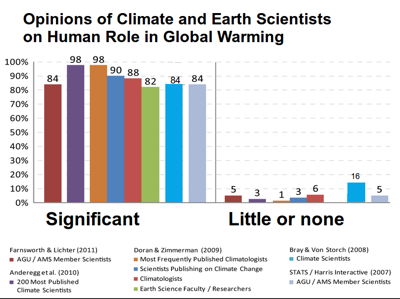
But the reality is that the scientific community has reached a solid consensus on the issue: There's not a single national or international scientific body that disagrees that the earth is warming, that we're causing it, and that the effects are likely to be catastrophic (e.g., flooding, drought, wildfires, etc.). And every single survey done of scientists about it shows that the overwhelming majority agree on all those counts as well. A disagreement between scientists exists only in the minds of those who have bought into the propaganda. It doesn't exist here in reality.
One of the deniers' tactics has been to try to paint those who believe in climate change as liberals. (So believing that scientists know a thing or two about science makes you a liberal?) But the truth is that about most Republicans believe in human-caused climate change. (source 1, 2, 3, 4) That includes nearly half of Republican legislators, too. Trust in science isn't the provence of only liberals, not by a longshot.
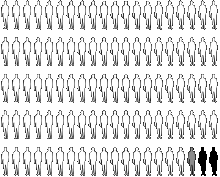
97–98% of the most published climate researchers say humans are very likely causing most global warming. (source)
For years, climate deniers tried to argue that the scientists got it wrong. That somehow, the deniers' understanding of science was superior to that of the world scientific community. (I think the word for that is "arrogance".) More recently, many deniers have switched to an argument only slightly less ridiculous: that climate change is a hoax. That is, nearly all the climate scientists in the world are lying about the issue, just to get grant money. The problems with that idea should be obvious:
- We're supposed to believe that nearly all the thousands of climatologists have abandoned their passion for science (which is itself a search for truth), and are intentionally trying to defraud the entire world, just to get some extra grants. It's more conceivable that Santa Claus will marry the Easter Bunny.
- We're supposed to believe that nearly every single body that
funds climate research is insisting that they get the "right"
results or that they'll yank the research funding.
Supposedly, governments all over the world (not just the
U.S.), universities all over the world, and non-partisan
private foundations are demanding bad science. And we're
supposed to believe that not only are all these groups are
pushing for the "right" answer, but that if scientists don't
play along they'll actually be out of a job, that
there is no funding available unless one is willing
to publish bad science.
In fact, the truth is quite the opposite: when George W. Bush was president, for example, scientists complained that his administration was fighting them, trying to downplay or exclude their findings. (source) How could the scientists lie about climate change occurring to get government money when the government wanted the opposite answer?
- We're supposed to believe that this subversion of research
funding, which would be the most massive fraud in all of
recorded history, and involving thousands and thousands of
people, has been effectively kept secret somehow.
- We're supposed to believe that not only did all the world's climatologists successfully fool most of the public, they also fooled all the other (non-climate) scientists. That's because the overwhelming majority non-climate scientists believe in global warming just like the climate scientists. But in the eyes of the deniers, non-climate scientists don't really understand the scientific process, they're just stupid.
But there's a more basic problem with the argument that the worldwide climate science community is intentionally giving the wrong answers in order to get grant money: there isn't any evidence for it. Rather, the deniers just state their assumption as though it were fact. It's a good tactic, because it forces the other side to waste time defending an idea for which absolutely no evidence has been advanced. Look how much space I devoted to it in this article, even though the argument has nothing at all to back it up.
Another favorite argument of deniers is that the original phrase was "global warming", but liberals switched it to "climate change" because the latter sounds scarier. In fact, both terms have been in similar use for decades, because, as anyone with even a cursory understanding of the issue knows, the two terms refer to two separate, distinct phenomena. Global warming is the process of the globe heating up. Climate change is the disruption of the climate that results from the warming. It's a rather simple distinction. When deniers insist that the term was changed for nefarious purposes, they unwittingly reveal a great deal about their lack of understanding. (more)
Yet another myth is that scientists used to believe that we'd have global cooling, but now they're saying it's global warming, so we can't trust the scientists because they can't make up their minds. The truth is that the idea of global cooling never had mainstream support from the scientific community. Ever. That contrasts sharply with global warming, which is supported strongly by scientists of every stripe all over the globe.
Perhaps the most commonly heard try from deniers is "The climate has always been changing." They say this as though they've made some sort of point. Indeed, the climate has always changed, but slowly. The thing is that climate is changing now rapidly, in relative terms. So their argument is a failure to understand degree. It's like saying:
- Bicycles and airplanes are both transportation, so they're both equally fast.
- Mice and elephants are both animals, so they weigh the same amount.
- Baby boys and adult women are both human, so they're the same in every other way too.
What most people don't know is that there's been a well-funded machine that's been trying to confuse the public about climate change for decades. It's the same tactic that the tobacco industry used to fight the science linking smoking with health problems: sow doubt in the public's mind. As a 1960s internal tobacco company document said:
"Doubt is our product, since it is
the best means of competing with the 'body of fact' [linking
smoking with disease] that exists in the mind of the general
public. It is also the means of establishing a controversy...”
(source)
Not only is it the same
tactics, in many cases it's actually the same people.
After Big Tobacco lost in its efforts to deny the science about
smoking and health problems, they tried to deny the science
between health problems and secondhand smoke, starting
in the 1990s. And many of the people working to attack the
science for the tobacco industry, are now the same ones trying
to attack the science of climate change, trying to convince the
public that the science isn't settled and that the scientists
are in disagreement. (source)
One way they sow doubt is to buy
some scientists. Wei-Hock Soon received over $1.2
million from the fossil fuel industry in exchange for publishing
papers deriding climate change and testifying to Congress that
climate change isn't caused by humans. And let's be clear:
this was definitely a case of the money buying the result, as Dr.
Soon described his papers and his testimony as "deliverables", as
discovered documents show. Further, until he was exposed,
his papers routinely failed to disclose his conflict of interest,
which in many cases violates the ethics guidelines of the journals
that published his work. This is all the more significant
because Soon is one of the few published scientists who has
dissented from the consensus position. With so few
scientists on their side, deniers' have relied heavily on the work
of Soon and a tiny handful of others. Soon being
discredited, now there are even fewer that they can point to. (source)
If you're paying attention,
you'll notice that both sides have claimed that money has
influenced the science. There are two differences,
though. The deniers are claiming that virtually all
the world's climate scientists have been compromised, while the
supporters point out that only the handful of denier-scientists
have mostly received funding from big oil and denier
thinktanks. That is, it's plausible that a few scientists
could have been compromised. It's not plausible that nearly
all of them were. Second, the deniers' claim that climate
change scientists are lying never comes with any evidence.
On the other side, we have the $1.2 milion that Dr. Soon received
from big oil, and the documents in which he described his papers
and his congressional testimony as "deliverables".
I'm not a scientist. And neither are the people who
argue with me about climate change. The difference between
us is that I'm trusting the consensus of the world scientific
community. They're trusting Rush Limbaugh and
Exxon-Mobil. Now, I suppose I could decide that the world
scientific community is wrong, but I'm just not that arrogant.
Selected reading:
- Scientific opinion on climate change (Wikipedia)
- The Climate Denial Machine (PDF). Detailed report showing how a small handful of paid professionals are sowing all the doubt about climate change (paid for by the oil industry and right-wing billionaires), and how many of them were the same flaks for the tobacco industry's anti-science crusade. Required reading for anyone who's eager to forward me some article that supposedly debunks climate change, since that article was almost certainly written by one of the paid P.R. people listed in the report.
- Meta-analysis of climate change research (American Association for the Advancement of Science. In nearly 1000 studies done over the course of a decade, not a single one rejected the consensus position)
- 176 arguments against climate change refuted (Skeptical Science)
- How to argue with a global warming skeptic (Science blogs)
- Climate change doubt paid for by Exxon-Mobil (Mother Jones)