

Solar panels:
Finally affordable!
Last update: Dec. 2015
Solar electricity systems have been just as cheap or cheaper than grid energy since 2013, in most places. It's unlikely to keep getting much cheaper, though, because most of the cost is now for labor and administrative expensive, not for the equipment itself. (SunRun)
You might have shied away from solar because you were wary of a large upfront cost — even with the promise of virtually-free electricity for 20+ years after that. But you can avoid the upfront cost by simply getting a loan to pay for the install and then making monthly payments on it. So, for example, you might pay $100/mo. on the loan, vs. $140/mo. for electricity if you didn't get the system.How much do solar panels cost?
The cost of a solar electricity system varies a
lot based on whether tax credits or rebates are
available to you. It's
as cheap as free, where incentives pay for 100% of the
cost of the system. On the other extreme, with no
incentives and a higher-than average cost of install, a system
might cost $53,000. For a typical home using 920 kWh/mo.,
that works out to 23¢/kWh over 21 years, which is a bit more
than the estimated 18¢/kWh average for grid energy over the same
period.
Most systems will cost somewhere between those two
extremes, and will be cheaper than grid energy.
Since system prices vary so much, that's why I made the
calculator at right. Put in your data and get an excellent
estimate of the cost for your particular situation.
Be careful to compare the monthly cost correctly!
First, don't compare the monthly cost shown in the calculator to
your current monthly electric bill, because your electric bill
will go up with inflation while your loan payments won't.
Instead, compare the monthly cost shown in the calculator to 1.5
times your current electric bill. Second, compare to the
cost of your per-kWh charges only, not to your whole
electric bill, because even if you have solar installed you'll
still be a utility customer (more on that later), and so you'll
still pay the monthly customer charge.
|
|
|
|
|
Grid energy, Hawaii |
|
|
Grid energy, Japan |
| 22¢ | Solar, worst case ($6k install, no rebate, no tax credit) |
|
|
Grid energy, Alaska |
|
|
Grid energy, U.S. average |
|
|
Solar, average case (tax credits but no rebates) |
|
|
Solar, best case (tax credits + rebates) |
|
Sources & Notes: Solar costs
calculated June 2014. Grid energy prices for
U.S. from DOE
Table 5.6 (2014), and for Japan from ShrinkThatFootPrint
(2011). Solar systems are expected to last for
21+ years. Solar tax credit is 30% of
installation cost after rebates. I
don't list solar lease programs because the vendors
don't bother to provide any sample pricing on their
websites.
More sources are listed above, in the article. |
|
The calculator probably won't show a huge savings from solar, but that's not the point: The point is, for about the same amount of money or a bit less, you can get your energy from a clean source. That is, there's no longer a price penalty for going green.
You might wonder, if solar is cheaper than grid energy, why isn't everyone going solar? For consumers, the answer is that most of them simply don't know it's cheaper. (That's why I made this web page, to share the news.) For utilities, they do know it's cheaper and they're investing in solar in a big way. In 2015, 40% of all new electric utility capacity was solar, way more than for any other source, and double that of natural gas. (SEIA)
Those versed in finance might complain that I'm not considering opportunity cost, or the time value of money. They might say you could take the money you would have spent on solar and invest it, which earns a return, so the relative cost of solar is thus higher, because you had to pay all the money up front. What that idea misses is that solar is also an investment: You're locking in your cost for electricity for 21+ years, and buying yourself out of inflationary increases for the price of energy. If you could get 6% a year with outside (non-solar) investments but you have to pay 4-5% more for electricity each year, then your investment returns are negligible when weighed against the extra electric cost, and thus the kWh costs I just quoted for solar are still pretty accurate. In fact, you might do even better with your solar investment — in 2008 dirty electricity costs went up by about 8%. And while the calculator assumes there's no opportunity cost, it also assumes that electricity rates won't rise. In effect, these two things pretty much balance each other out.Realize that the size of the system you get is actually arbitrary, because you're won't be making all your own energy. During the day, you'll probably make more than you use, and sell the excess back to the utility. In the evening when there's no sun, you'll be buying electricity from the utility like normal. So, you could get a system that makes 75%, 100%, or 125% of what you use.
When getting bids, you'll see the term solar
photovoltaic or the acronym solar PV.
That just means a solar electric system, as opposed
to a solar water-heating system (which Mr. Electricity has for
his own home, by the way).
Why is solar so cheap now?
- Panel price has plummeted. The
cost of solar panels has taken a deep, deep dive in recent
years. So much so that I don't expect them to
continually get much cheaper, but then again, they don't
have to, because they're already affordable.
- Federal
Tax Credit of 30%. If you install a
$20,000 system, you lower your tax bill by $6,000. The
credit is 30% of your cost, after any state/local rebates
you get. (Case A in the calculator assumes a rebate,
so the tax credit in that example is lower.) Note that
a tax credit is more powerful than a tax deduction.
A deduction just reduces the amount of your income,
on which the tax is based. But a tax credit
comes directly off your total taxes. The credit is set
to expire at the end of 2016 unless Congress renews it, but
even if they don't, solar should still be affordable.
- State & local rebates. This is
cash back from the government or utility company for
installing solar. But they're becoming increasingly
rare, since solar costs have dropped so much that
governments don't feel they have as much need to subsidize
it.
- SRECs (Solar Renewable Energy Credits).
In some northeast states, you earn credits called SRECs from
generating rooftop solar, which you can then sell in a
marketplace for about 15¢/kWh. SRECs aren't available
in most states, but where they are, they make the systems
essentially free. I have a separate page all
about SRECs.
- Increased Competition. Now that solar is getting popular, more installers are entering the market. When there was just one installer in your area they didn't have to try very hard to get your business if you wanted solar. Now they do.
Solar leasing programs
While the traditional way to get solar has been to buy system and finance the install, in some places you can actually rent a solar system. The company installs the system, and then you pay them a monthly fee, which is less than you're currently paying for electricity. Companies that rent out solar include SolarCity, Sun Run, and SunPower. (SunEdison offers a commercial rental program for business customers.) However, it's usually better to buy the system yourself instead of leasing one, because then you enjoy the federal tax credit, and there are no obstacles to selling your house in the future. (If you have a lease, any potential buyer has to be willing to take over the lease payments, unless the leasing company lets you move the system to a new home or lets you end your lease for a fee.) See criticism of solar leasing programs at NACHI, Solar Home, and Solar Lease Disadvantages.
How does a solar PV system work?
A complete solar photovoltaic system consists of:
- Solar panels
- Inverters, which convert DC electricity into AC
- Service panels to tie the output to your home's wiring, and to let you send excess electricity back to the utility
 A
system could also have batteries to store extra
electricity. This would allow you to live completely off
the grid if your system were big enough and if you were good
at conservation. But it also increases the cost and
maintenance requirements substantially, so I recommend you
pass on the batteries. It's easier just to send the
excess you generate back to the utility and get paid for it.
A
system could also have batteries to store extra
electricity. This would allow you to live completely off
the grid if your system were big enough and if you were good
at conservation. But it also increases the cost and
maintenance requirements substantially, so I recommend you
pass on the batteries. It's easier just to send the
excess you generate back to the utility and get paid for it.
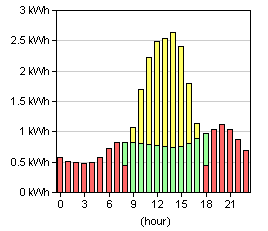
With a battery-less system, sometimes you'll be using grid energy and sometimes you'll be using solar energy. Here's a chart showing a hypothetical system:
- Red bars. At night when the sun's not shining, you'll be getting your electricity from your local utility.
- Green bars. During the day, your system will make some electric and you'll use it right away.
- Yellow bars. During the day you'll make more electric than you need, and you'll sell that back to the utility.
So as long as you're still connected to the grid, the size of a system is kind of arbitrary. You could have a tiny system that simply fuels part of your needs with green energy, or you could have a massive system which still won't fuel all your needs, because it won't run at night.
How much roof space is required?
How big a system do I need?
|
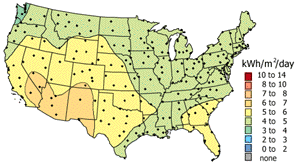
Annual average daily solar radiation per month (using a flat-plate collector facing south at a fixed tilt equal to the latitude of the site, which maximizes input). The scale is the same for peak sunlight hours. For example, yellow-shaded areas get an average of 5 to 6 hours of peak sun per day. (from NationalAtlas.gov) |
The size of your system is arbitrary—you can pick any size you want. That's because in most cases you'll still be connected to your utility, so you don't have to try to generate 100% of your needs 100% of the time. You can get a smaller system to supply, say, 80% or 50% of your needs, which lowers the system cost. Even with a small system, you're still reducing the amount of pollution being generated at the power plant, because you'll be using less of their electricity. You could also go the other direction, getting a system to make 150% of your needs, selling the excess you generate back to your utility company. The point is, the size of your system isn't something you figure with a calculator, it's your own personal preference.
If you want to go completely "off the grid"—that is, disconnect from your utility company—then the cost of installation soars. The first thing you have to add is batteries, to store excess energy during the day so you can use it at night. Then you need a huge system, to make and store lots of extra energy to use for other times when the sun doesn't shine. For most people there's no need to go this route—you can just remain connected to the grid, and then get any size system you want.
Many people size their system to match the amount of electricity they use, even though sometimes they'll be getting some of that energy from the grid, and sometimes they'll be sending excess that they generate back to the grid. See the previous section for more on that. Let's say you want to go that route: How big a system do you need? Here's a rough estimate, based on a typical house.
|
Rough estimate of solar system sizing to generate 900 kWh/mo |
|||
| |
|
||
| |
|
|
|
|
Size of system |
|
|
|
|
Space required |
|
|
|
This calculator from FindSolar may give you a more accurate idea, since it's based on your actual zip code (so they can tell how much sun you're getting) and how much you're paying for electricity each month (so they can tell how much electricity you're using).
kWp is just the units we use to measure the system. Sometimes it's just referred to as plain kW. It's not important to know what kWp means. (But if you must know, it stands for kilowatt-peak, which is the maximum possible output of the system at any point in time.) Each kWp generates 105 to 135 kWh of electricity each month, depending on where you live on the map.
Here's how you can find how large a system you need to generate as much energy as you use:
- Figure your daily usage. If you use 900 kWh/mo., that's 900 kWh / 30.4 days per month = 29.6 kWh/day.
- Figure how many kWh you need to generate each hour. From the map above you can see that if you live in a yellow area that you'll get 5 to 6 hours of peak sun per day on average. We'll call that 5 hours/day to be conservative. Since you need to generate 29.6 kwH/day, you need a 29.6 kWh / 5 hours = 5.92 kWp system.
- Add a safety margin. Multiply by 1.25 to account for shading, dust, and bad feng shui. So 5.92 kW x 1.25 = 7.4 kWp. We need a 7.4 kWp system.
Each 1 kWp of system takes about about 100 s.f. (10' x 10') of roof space.
Note that there's no reason you have to put the system on the roof. If you're willing to give up some yard space, you can put the panels on poles on the ground. This is a good choice when the roof is shaded by trees and doesn't get enough sun. Putting the panels on the ground is also nice because then the panels can be easily arranged at the optimum angle to get the most sun, while on the roof you're limited by the ridgeline of the house.
You can't put panels on every face of your roof because it's only economical to put them on the parts that get the most sun. You typically want the panels facing south. Panels facing east or west might barely be acceptable, maybe. Panels facing north are useless.
Remember, if you don't have "enough" roof space it's not really a problem, because system size is arbitrary. Whatever system you install will simply mean that some portion of your electric needs comes from green energy.
Here are other solar maps and calculators for those wishing to run their own numbers:
- U.S. Peak Hours map from Wholesale Solar.
- U.S. solar maps from NREL.gov.
- U.S. Combination Calculator/Map. Lets you choose Average, Maximum, or Minimum; for the whole year or just a specific month; and according to how well your equipment is aimed at the sun. Wow!
- U.S. Cities table. Lists summer, winter, and average peak hours per day for tons of U.S. cities.
- World peak hours calculator. Choose your country / city and get detailed info. Takes a few clicks to get to what you want, though.
How much electricity does a solar panel generate?
For home energy, it's generally better to use the method above: Start with your monthly needs for electricity, then calculate how big a system you need. But if for whatever reason you want to know how much energy you can get from a solar panel, here's how to calculate it. First start with the number of hours of "peak sun" you get per day. That's easy: In our map above, it's 4 hours for green, 5 hours for yellow, and 6 hours for orange. Then multiply that by the peak output of your panel, then by the number of days per month. For example, for a panel rated at 150 watts in New York, we'd have:
4 hours peak sun x 150 watts panel x 30.5 days per month ÷ 1000 kWh/watt-hour = 18.3 kWh/mo.
Solar panels do NOT take more energy to make than they generate
Somehow the myth got started that it takes more energy to make a solar panel than the panel generates in its lifetime. But that's simply not true. The energy payback time on a panel is typically less than two years (CleanTechnica, WP), and most panels will produce useful electricity for 25 years or more. So if you were worried that solar panels were energy wasters in disguise, relax. They're not.
How long do solar panels last?
Solar panels typically last at least 25 years, though their output decreases slightly over time. Some manufacturers offer 25-year warranties, guaranteeing that their panels will put out at least 80% of their stated capacity after 25 years. A panel that continuously degrades to 80% capacity after 25 years puts out the same amount of energy as one that puts out 100% for 21 years, so that's why I use 21 years as the panel lifetime in the calculator above. (More on 25-year lifetime from the BBC and Scitizen.)
Google goes solar in a big way
In 2007 Google built a massive 1.6-megawatt solar system at its headquarters in California. It generates 30% of Google's peak demand, and around two million kWH a year. It's the largest corporate solar install in the U.S. (There are larger installations at utility companies, but this is the biggest for a company generating its own electric.)
It doesn't end with this huge installation. In late 2007 Google announced its plans to develop a whopping one gigawatt of energy from renewable sources at a cost cheaper than coal, and to do it "within years, not decades". Wow.!
Other info on solar
The Wikipedia article on solar electricity is impressively comprehensive.
Wind power compared
Most places in the U.S. aren't windy enough to make
wind power cost-effective. And even in windy areas
the price could still be more than grid electricity. An
$18,000 system ($12,600 after the tax credit) that produces 3800
kWh a year in a windy place with 12mph avg. windspeed will
produce 76,000 kWh over its 20-year life, for a cost of $0.17
per kWh. That's much more than grid energy, and way more
than solar.
Wind power resources:
- Here's a quieter wind turbine, since many models are fairly loud.
- Average
wind
speed by city, and a wind
map of the U.S. You need avg. windspeed of about
12mph (5.5 meters per second) to make wind power approach
cost-effective.