This site is used as a homework reference in:
Stoughton High School (Pat Schneider's economics class)
|
|
|||||||||||||||||||||||||||||||||||||||||||||||||||||||||||||||||
|
||||||||||||||||||||||||||||||||||||||||||||||||||||||||||||||||||

|
<< Back: Down Payment << |
>> Next: Assuming a Loan >> |
Basics
The loan you get from the bank is called a mortgage, also called a note. (We'll talk more about how to get a loan in a minute.)The bank loaning the money is the lender. The amount you pay to the bank each month is your mortgage payment. The rate of interest on the loan is the mortgage rate (or the interest rate).
If you don't make your mortgage payments then the bank will repossess the house. (This is called foreclosure.) Then they'll sell it to make sure that they can recoup the money they loaned to you, and that you didn't pay back.
The number of years it takes to pay back the loan is called the term, which in the U.S. is either 15 or 30 years. There are pros and cons of each:
15-year mortgage
30-year mortgage
• Saves a bundle on interest
• Pay off the loan in half the time• Easier to qualify for
• Lower monthly payments
• Allows you to buy a higher-priced home
• Keeps your cash liquidHow do you choose between the two? If you want the most flexibility then take the 30-year loan. You can still save on interest and pay your loan off early by paying the bank a little extra each month (or whenever you can afford it). The difference is that with a 30-year loan you get to dictate how much extra you want to pay, and therefore how much you want to save. With a 15-year loan you have to make bigger payments every month whether you like it or not.
On the other hand, if you can definitely afford the payments on a 15-year loan, and you don't trust yourself to make extra principal payments on a 30-year loan, then take the 15-year loan and enjoy the fact that you'll save a bundle of interest and pay off the loan in half the time, without having to do anything special.
If you're satisfied with that advice then keep reading. Otherwise you can check out more about 15- vs 30-year mortgages in the appendix.
Right now you should figure out how much money you have saved up that you can use for a down payment, unless you know you can get a loan with no down payment.
Paying back a mortgage
You pay back your loan by making a payment every month. At closing you'll usually have the opportunity to sign a form which lets the bank draft the payment automatically from your bank account each month, which is very convenient. If you decline to do the auto-draft, then it's your responsibility to make your payment each month on your own initiative. The bank won't send you a monthly bill.Part of your payment goes towards the principal (the amount the bank loaned you), and part of it is interest (the bank's profit from lending you money). So when the bank loans you $100,000 you pay them back that $100,000 and then some. If you only had to pay back the same $100,000 they gave you then there wouldn't be anything in it for them. That's why they charge interest.
Even though part of your monthly payment is for principal and part is for interest, you make only one payment to the bank each month, and that payment amount stays the same for the life of the loan. You don't have to know how much of your payment is for principal and how much is for interest, and you generally don't need to know, but if you're curious, you can see my page on how to figure mortgage interest. At the end of the year the bank will send you a statement for your taxes (since you'll get to deduct the interest you paid if you itemize), and the statement will tell you how much interest you paid over the year.
Mortgage interest
Interest is the fee you pay for the privilege of borrowing money. It's how the bank makes a profit by giving you a loan. Naturally, the lower the interest rate, the better for you, because you'll pay less total interest. And since the interest is part of your monthly payment, a lower interest rate means a lower monthly payment, too. Finally, a lower interest rate means you can afford a more expensive house. (Let's say you've got $1500/mo. to pay towards a home. When less of that $1500 goes to interest, more of it can go towards paying off the cost of the home, which means you can afford a pricier house.) So when you get to the point where you're shopping for a loan, you'll try to get the lowest rate possible.
Incidentally, in June 2012, U.S. mortgage rates dropped to a record low of 3.66%, the lowest rate since 30-year mortgages started in the 1950s. (MSNBC) HSH has a list of historical mortgage rates since 1986.
Maybe you remember percentages from high school, so you figure that if you have a $100,000 loan at 6% you'll be paying the bank back $106,000? Nice try, but that would work only if you paid back the loan after one year. The 6% rate is an annual rate, so you're going to pay that 6% every year. (You won't pay quite as much as $6000 x 30 though, because you pay interest only on the outstanding balance, not the original loan amount, and as time goes by your balance gets lower.)
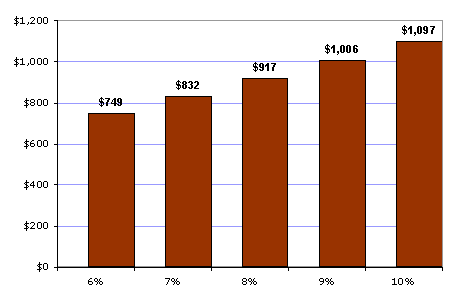
The actual amount of interest you pay each month is the current outstanding balance, times the interest rate, divided by 12. (e.g., For $150,000 left on a loan at 6%, means you'd pay $150,000 x 6% ÷ 12 = $750 in interest for that month.) If your eyes just glazed over then don't worry about it, it's not important to know the math now, I just provide the details for those who want to understand everything completely. Here's all you need to know:
- Over the life of the loan, you'll be paying the bank a lot more than just the interest rate times the loan amount.
- When comparing loan offers from two different banks, just a single percentage point of difference means a big difference in how much interest is paid.
- For the first several years most of your payment goes to interest, not principal. On a 30-year, 7% mortgage, in year #15 over 75% of your monthly payment goes to interest and not equity. After 15 years you won't own half your house, you'll own only 27% of it.
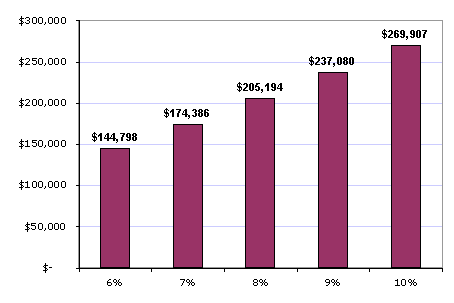
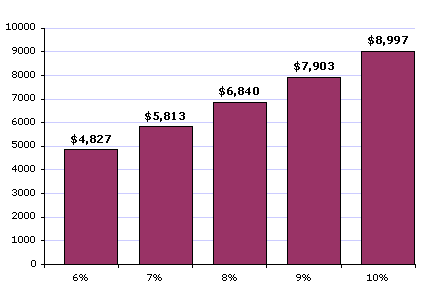
Here are some pretty pictures to demonstrate the first two points. We'll assume a $125,000 loan for 30 years at various interest rates.
Total Interest Paid Over the Life of the Loan
So even at a very low interest rate of 6%, you're paying $145,000 in interest on a $125,000 loan. So you borrow $125,000 and pay back $270,000 — more than double what you borrowed!
It's even worse if you have a higher interest rate. Note how going from a 6% to 10% interest rate means you pay an extra $125,000 over the life of the loan. So the total you'd pay on a $125,000 loan at 10% would be $125,000 principal + $269,907 interest = $394,907! Quite a lot to pay back for a $125,000 loan, huh?
Average Yearly Interest ($125,000 loan, 30 years)
Here again, going from 6% to 10% interest means you pay an extra $4000 on average in interest each year!
How the interest rate affects the monthly payment
Types of loans
For the most part, you don't have to concern yourself with the difference between the three main kinds of loans (Conventional, FHA, and VA loan). It's your lender's job to try to pick the best loan for your needs and qualifications, not yours. But since you'll hear these terms bandied about frequently, you might want to know what they mean, so here ya go.Conventional. This is a fancy word for "normal". A conventional loan is just a regular, normal loan. If your credit is good and you can swing at least a 5% down payment, then it's better than an FHA loan, since the fees are a lot lower, and there's less red tape.
FHA. The U.S. government offers the FHA loan program to make home-buying easier. These loans are generally easier to qualify for, and can be had for down payments as low as 3.5% (vs. 5% for conventional loans). The loans aren't actually made by the government, they're still made by the banks; the feds just guarantee part of the loan if you default, which means that they pay the bank if you fail to make your payments. Don't get excited about the government making your payments for you, though — if you fail to make your mortgage payments the bank will still take the house back from you. The feds pays the bank after the bank has already repossessed your house. Note that not all sellers will agree to an FHA loan, because there's a little more red tape involved.
Also, one flavor of FHA loans is the FHA 203k, which will let you borrow any money needed for additional repairs or modernization. For example, if you're buying a $170k home, and it needs $30k of repairs, you could borrow $200k through an FHA 203k. In fact, the FHA 203k is usually the only way you can borrow a lot of money for initial repairs. The downside is that the interest rate on such loans is about one percentage point higher.
VA. VA loans are an option for veterans, and it's possible to put 0% down on one. Just like with FHA loans, the VA itself doesn't lend money, it just guarantees part of the loan so lenders feel comfortable lending the money. VA-guaranteed loans can be combined with second mortgages (which is when the bank makes the main loan covering most of the price of the house, and the seller makes a separate loan to the buyer for the rest of the price.) VA loans can be assumed by any future qualified buyer, so your hands aren't tied if you need to sell — you can sell to anybody, not just another veteran. (visit the VA's home loan site for more)
<< Back: Down Payment <<
>> Next: Assuming a Loan >>
Last
update June 2013
If you liked this site then you might like some of my other sites:
How to Find Cheap Airfare
How to Save Electricity
Slot machines demystified
Entire site ©1999-2023 Michael Bluejay Inc. • All information is "use at your own risk" Contact