As you know from the Credit
Reports
& Scores page, you improve your credit score
by cleaning up your credit report. Below
are the tried-and-true ways to clean up your credit
report. This is truly everything you need to know.
Don't pay for credit repair services, because they can't do
anything for you beyond what's listed here.
Late payments & collections
Credit scoring myths
Myth:
Checking my credit score or getting my credit
report hurts my credit score.
FACT:
No, it doesn't. Inquiries about your report for
the purpose of establishing new credit can
decrease your score a little bit, but inquiries to
just get your score or a copy of your report never
hurt your score. And even though inquiries for the
purpose of establishing new credit reduce your
score, they usually don't reduce it by very much.
Myth:
Closing credit card or merchant accounts will help
my credit score.
FACT:
Closing accounts generally won't raise your score.
People have heard,quite correctly, that sometimes
having too many open accounts can hurt your score.
That's true, but once you already have the open
accounts it's too late. If you close accounts now
then your ratio of outstanding debt to credit
available will rise, which will hurt your
score.
Now, if your lender
asks you to close an account or two as a condition
of getting the loan, then go ahead and do so. You're
not doing so to raise your score, because it
doesn't, you're doing so because your lender says
that what it takes for you to get the loan. The
reason they might do this is because they're afraid
if you max out all your various cards you'll be
spread too thin and won't be able to pay back the
mortgage. So they may want you to close an account
or two to reduce your ability to rack up more debt.
But you should close accounts only if your lender
says you need to do so in order to get the loan. If
a mortgage broker suggests you do so, ignore
them.
|
Don't make any (more) late payments. Make
sure you pay every bill on time from here on out. Taking
steps to bring your score up does you no good if you do things
that send it right back down. Also, the older a late
payment is on your credit report, the less it hurts you.
So a late payment you made last month hurts a lot right now,
but in two years that same late payment won't hurt your score
as much. If you make no more late payments, your score
could improve 50 points within a year.
Pay
off collections. If you're very late in
paying a bill (at least a couple months, usually longer), the
creditor might sell your debt to a collection agency, who will
then hound you for payment. Any debt you owe to a
collection agency rather than the original company is called a
"collection". If you have any collections, try to pay
them off first, because they hurt your credit score the
most. That won't remove them from your credit report,
but it will still help your score, because a late payment
is not nearly as bad as an unpaid debt. Tip:
Many collection agencies will offer a discount if you agree to
pay the balance in full while you're on the phone with them
(via a bank transfer).
Correct
errors. If there are any errors on your report
(such as late payments when you weren't late), write a letter
to the CRA in question and ask that the error(s) be removed.
The CRA has 30 days to investigate; they'll write to the
creditor and ask them to verify the payment info. If
they don't, the CRA will remove the negative info from your
file.
Make
sure negative info older than 7 years isn't reported.
By law, negative information in your credit report must
be deleted after seven years (10 years for bankruptcy). If
your report contains negative info that's more than seven
years old, write the CRA and ask them to remove it. Also note
that if you missed a payment 8 years ago, but it took the
creditor 2 years to report it to a collection agency, it will
likely show up on your report as a 6-year-old debt. In
that case, write to the CRA and explain that the debt is
really 8 years old and should be removed. Include a copy
of any paperwork that supports your claim.
Add
your side of the story. If there is
negative info in your report (such as non-payment of a debt),
but you have a good reason for not paying the debt
(merchandise not received, legitimate dispute with the
merchant who would not negotiate in good faith, etc.), write
to the CRA and ask them to add your short explanation about
the matter to your file. If the lender pulls your credit
report they might see the statement you added. They might not
see it, because some lenders just look at the credit score and
don't scrutinize the report itself too closely, but it
couldn't hurt.
Paying down credit card debt
Pay
down credit card debt. The more debt
you're carrying, the lower your score. Your debt is
compared to the total credit available to you. It's
called your credit utilization ratio. So $3000
of total debt with a $5000 total credit limit ($3000 ˜ $5000 =
60%) is worse than $3000 of debt with a $10,000 limit ($3000 ˜
$10,000 = 30%). So pay down your debt to increase your
score. Go for at least <30%, but <10% is even
better. Surprisingly, 0% is worse than 1-9%: they want
you to have some debt, just not a lot of it.
Once I made a single $11,340 purchase on a card
with a $12,000 credit limit. Even though my total credit
available was about $188,000 on all my cards and I had only a
few thousand dollars outstanding on my other cards, that one
purchase near my credit limit on that card plunged my scored
nearly 70 points from 825 to 757 in a single month. However,
once I paid off that charge, my score zoomed right back up by
68 points the very next month.
The power of time
Wait. Credit scores get better with time, just
like wine. The older a late payment is, the less it
hurts you, and the older a credit card account is, the more it
helps you. If nothing else changes, your credit score
will gradually creep up on its own.
Getting credit if you don't have any
Get
and use a credit card. In most cases you need
to have (and use) at least one credit card in order to have a
good credit score. If you don't have one, get one. Just
use it to buy your groceries, and pay it off in full every
month. Here's more on getting a
credit card.
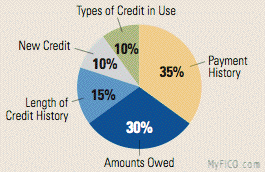 Ignore
everything else
Ignore
everything else
Ignore
most other advice you hear. Myths about
what actually helps or hurts your credit score would fill a
book. Some of them are listed in the sidebar
above. Some of them are even espoused by people whom
you'd think would know better, like mortgage brokers.
But the list you're reading now is all you need to focus
on. Be skeptical of any other advice you may hear about
how to improve your score. If it sounds legitimate and
you want to believe it then try to verify it first somehow,
don't just accept it on faith. Because taking bad advice
might not just fail to improve your score, it could actually
hurt it. Really, just correct errors, get old negative
items off your report, maintain a good payment history, keep
your credit utilization low, and that's pretty much all you
need to do.
Don't
pay for credit-rebuilding services. The tips
in this section are everything you need to know about
rebuilding your credit. There isn't anything else.
Nobody can do anything more for you than what I've listed
above. Don't throw your money away on credit repair
services.
Late payments are removed from your credit report
once they're over 7 years old. Bankruptcies are
removed after ten. If it's only going to take a few months
for a negative item to expire off your report, and you don't
have a specific dream house in mind that you want to buy right
now, then sure, go ahead and wait for the bad item to expire
before applying for a loan, so you'll have a higher credit score
and get a better interest rate.
But what if you have found your dream house that's
on the market right now? If you don't buy it now,
someone else will probably buy it while you're waiting for
your credit report to improve. In this case, figure out
how much extra you'll pay because of the higher interest rate,
and see if you're willing to pay that premium in order to get
your dream house. And remember that once your score
improves, you can always refinance at a better rate later on.
If it's going to take a couple of years for your credit
score to improve, and you're able to get a loan now, you
should probably do so rather than wait. Yes,
you'll pay more interest, but you'll start your investment in
your house that much sooner, which will balance out the extra
interest you'll pay. And once your credit score
improves, you can usually refinance at a lower rate (unless
rates happen to go up in the meantime).
Entire site ©1999-2023
Michael Bluejay Inc. • All information is "use at your own risk" Contact
