This site is used as a homework reference in:
Stoughton High School (Pat Schneider's economics class)
|
|
|||||||||||||||||||||||||||||||||||||||||||||||||||||||||||||||||
How mortgage interest worksLast update: October 23, 2023 SummaryMortgage interest probably works different from what you expect. Here's the summary:
How it worksLet's say you borrowed $400,000 to buy a house at an interest rate of 8%, for 30 years. To find the interest we owe for the first month, first we take 8% of the $450,000 balance, which is $36,000. Then we divide by 12 because there are 12 months in a year, and you're paying interest only for that month. So $36,000 ÷ 12 = $3000. That's how much interest you pay in the first month. The total payment on your loan is $3302, so $3000 goes towards interest, and only $302 goes towards principal. So, you've paid down your loan by only a measly $302. Your principal balance is now $450,000 - $302 = $449,698. When the next month comes around you owe interest only on $the $449,698 outstanding balance. Your interest in the second month is $449,698 x 8% ÷ 12 = $2998. Your payment is $3302, so with $2998 going to interest, this month you pay down your loan by ($3302 - 2998 = ) $304. Here's how it looks in table form:
That's certainly depressing. After four monthly payments of $3302, you've paid $13,208 total, but you've only paid down your loan by $1220! The only good part of this is that as time goes on, more and more of your payment goes to principal and less and less goes to interest. But most of your payment will go to interest for a very long time. Here's what it looks like in graphical form, with a lower interest rate than the example above.
|
||||||||||||||||||||||||||||||||||||||||||||||||||||||||||||||||||

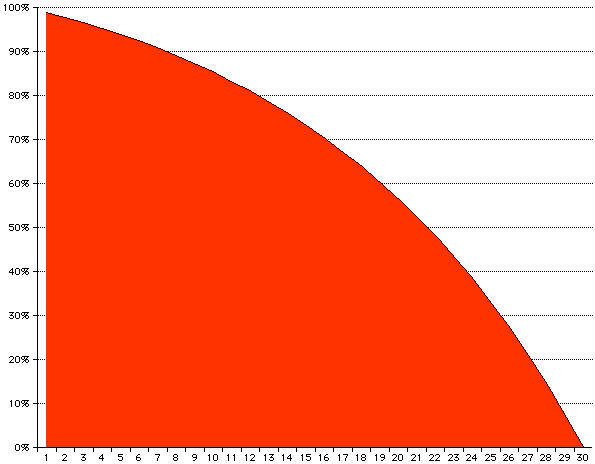
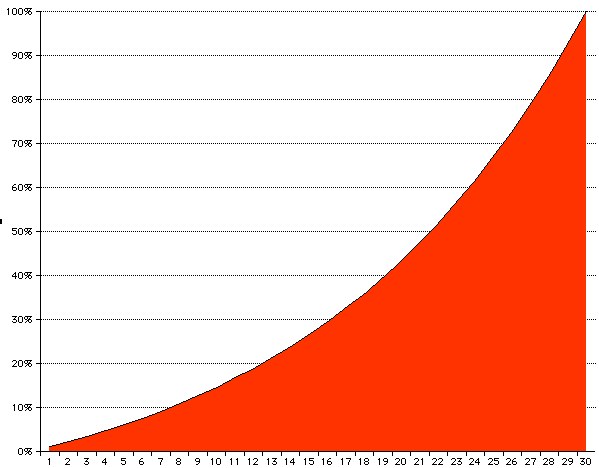
| Paying down a $450k, 15-year mortgage @ 8% | ||||
|
Month |
Principal |
Interest Paid |
Principal Paid Down |
Percent of payment |
|
1 |
$450,000 |
$3000 |
$1300 |
69.8% |
|
2 |
$448,700 |
$2991 |
$1309 |
69.6% |
|
3 |
$447,391 |
$2983 |
$1317 |
69.4% |
|
4 |
$446,074 |
$2974 |
$1326 |
69.2% |
The monthly payment on a 15-year mortgage is higher than for a 30-year mortgage, and the extra money pays the principal down faster. Since your outstanding debt is shrinking faster, there's not as much debt each month to pay interest on, so you pay much less interest over the term of the loan.
Here's a calculator showing the difference.
Making prepayments
You might not be able to qualify for a 15-year mortgage, since the payments are higher. Or you might already have a house with a 30-year mortgage. In these cases, if you can afford it, you can make extra payments on your principal each month, which pays off your house faster and saves on interest. Just make sure that your mortgage agreement doesn't contain a prepayment penalty clause. (Most don't.)
How much should you prepay? We cover that in our separate article about how to make prepayments.
Related topics:
If you liked this site then you might like some of my other sites:
How to Find Cheap Airfare
How to Save Electricity
Slot machines demystified
Entire site ©1999-2023 Michael Bluejay Inc. • All information is "use at your own risk" Contact