


"Power Factor" and devices that claim to save energy by fixing it
NOTE: After writing the
article below, a reader wrote in and claims to have
measured savings with a power factor device through the
only test that matters: clocking your electric meter.
While I'm still skeptical, given the extreme reader interest
in these devices, it's clear that I need to test one myself
to put the matter to rest once and for all. I won't
have time to do so until 2011 at the earliest, but when I do
I'll report the results here. In the meantime, below
is my position on power factor devices, until I see good
evidence to the contrary. And again, the only
evidence that is acceptable is a before and after test,
clocking the actual utility company electric meter each
time. Before-and-after electric bills are completely
worthless for substantiating whether these devices really
work or not.
Before I give the technical explanation about these devices, let me give you the summary: These devices won't save electricity in your home. Don't waste your money on them. They do correct your power factor, but utilities don't charge home users for bad power factor. You weren't paying a penalty before installing the unit, so you won't see any savings after you put it in.
Now, some commercial customers are billed for bad power factor, if their power factor is very bad. For those users it might make sense to install PF-correction equipment. But not home users.
Besides the fact that these things don't work for home users, there's something else about them that rubs me the wrong way: Many people are just looking for a quick fix, some device they can just buy and plug in so they don't actually have to make any effort to conserve energy. Please, let's move beyond that. Saving electricity really isn't that hard, and the amount of energy a household could save by not being wasteful is tons more than could be saved by one of these little plug-in devices, if they worked (which they don't). So let's stop pinning our hopes on tech scams and instead simply use less electricity.
 Okay,
so let's talk about "power factor". Without getting
too technical, sometimes more power goes into a device than
you'd expect, because of a special kind of inefficiency.
The actual power used by your device is measured in kW, and
that's what you're charged for. If your device uses only
80% of the power going into it, the power factor is 80%.
Power factor is the Real Power (the amount your device actually
uses) divided by the Apparent Power (the total going into
it). For example, 80 kW (Real Power) ÷ 100 kVA (Apparent
Power) = 80%. And again, residential customers are charged
only for the Real Power, not the Apparent Power.
Okay,
so let's talk about "power factor". Without getting
too technical, sometimes more power goes into a device than
you'd expect, because of a special kind of inefficiency.
The actual power used by your device is measured in kW, and
that's what you're charged for. If your device uses only
80% of the power going into it, the power factor is 80%.
Power factor is the Real Power (the amount your device actually
uses) divided by the Apparent Power (the total going into
it). For example, 80 kW (Real Power) ÷ 100 kVA (Apparent
Power) = 80%. And again, residential customers are charged
only for the Real Power, not the Apparent Power.
There are a number of devices which increase the power factor or recycle the reactive power. What's more, this is supposed to make your equipment run cooler and last longer. The devices either plug into an empty electrical outlet, or you have an electrician install it at the service panel. But since home users aren't billed on power factor, there's no savings to be had.
And even if the utility billed home users for bad power factor, modern appliances already have this kind of power-correction built-in. For these appliances, there's nothing left to "correct". Consumer Reports says the average American home already has a power factor of 90%, which would make the maximum savings close to only 10% (if the utility actually charged you for the power factor penalty, which they don't).
But what about saving energy for green reasons, even if it
doesn't save any money? Sorry, no dice. The
savings here is just very small. It's actually less
than you'd expect: If your power factor is 90%, there is
way less than 10% savings to be had. Here's more
info on that one.
A utility company employee writes:I work for a utility in Ontario and we have tested these devices in our shop, and these devices are a scam for residential billed customers. They do correct the power factor but since residential customers are only billed on kw.h they do nothing to reduce a customer bill. That is loads use watts, and residential customers are billed on watts, so it doesn't matter what the PF is. Our tests not only proved this but that these devices actually use a small amount energy, which ironically drives the customer bill up. PF only comes into play with larger commercial customers who are billed on Peak Demand. The theory is that customers use Watts and the utiltiy supplies VA, so for the same load (watts), the lower the PF the more the utility must supply in VA. To combat this the utility bills is the higher of Watts or 90%*VA, thus the customer is charged more for a low (bad) PF, thus they can reduce their demand charge by raising (or fixing) their PF. PF is lowered by inductive loads, thus adding capacitance raises it. These little expensive devices are just capacitors. I read the white papers on these devices, and they did not report anything that was untrue, but the advertising is very misleading. Some of the technical people at our work were fooled, until it was explained and our results revealed.
Another writes: Our residential meters don't measure reactive power. You can't save money by plugging in a reactive power correction device.
Consumer Reports also confirms that residential users don't pay for bad power factor. |
The proof of the pudding is in the eating
The websites for products like these extol supposed testimonials from residential customers, who are simply looking at their bill month over month. Frankly, that's a ridiculous way to evaluate whether the product works or not. Energy use from month to month can vary for all kinds of reasons. The only meaningful way to test one of these products is to clock the electric meter before and after the product is installed, with the same exact devices running in the house. That's the only kind of test I will perform, and that's the only kind of demonstration I'll accept. Period. (Yet clueless sales reps and customers keep offering to send me their electric bills, as though that wasn't completely useless.)
Power factor box manufacturers are always trying to impress me with alleged testimonials from their supposed customers. But in fact nothing could impress me less. Those customers almost certainly didn't do the proper kind of test, and I have no way of verifying their honesty anyway. In short, if I don't see it myself firsthand, I'm not buying it.
Some of them have videos showing some kind of meter connected that shows some kind of reduction. This is also the wrong test, because the question isn't whether the power factor is corrected, it's whether there's a reduction at your electric meter. Okay, so one of these companies has a video showing it connected to an electric meter -- sitting on a table! Not an actual electric meter in use, installed at the house. No one has ever produced a video of an actual installed residential electric meter showing a decrease in usage with one of these devices connected. Why on earth not, when it's an easy test to do, and when it's the best proof available? Probably because the devices don't work.
Here's another thing: If these devices really worked, then companies would be falling all over themselves to get me to test them or to demo them for me so they could get the free advertising from me. I get several thousand visitors to this site every day, why wouldn't they want that? The fact that I don't hear from them in and of itself is telling. It's not because they don't know about this site. It's the #1 site on the net for saving electricity, has been mentioned in Newsweek, and frankly, if you're in the electricity-saving business, you know about it. Also, when a manufacturer writes to me to gush about how much energy their product saves, I say, Fine, send me one to test. And then I never hear from them again. I was going to link to the last manufacturer that happened with but I just tried to check their site and it crashed both my browsers.
For nearly ten years I had an open offer for manufacturers
to send me their device to test, but no one ever took me up
on it. As of January 2010 I'm retiring this offer
because I won't be able to test one until fall since I'm
traveling, and at that point I'm just going to buy my own to
test it.
By the way, last summer I went to the website of the most well-known power factor box maker, but I couldn't find any guarantee mentioned anywhere on the site. I called and they said they'd email it to me, but what I got was some barely literate rambling jargon that wouldn't pass as a guarantee in any court on this planet. I wrote back and asked if they'd agree to a simple statement (something like they "guarantee that the unit will reduce energy consumption as shown at the residential electric meter"), but they didn't write back. I called, we traded voicemails, but then after my last message I haven't heard from them.
My test of two different plug-in units shows that they don't work
One reader bought a unit and sent it to me to test, and I'm happy to do that, but realize that you can perform the same test yourself:
- Turn on everything in your home.
- Go outside and clock your electric meter. (See how fast it spins.)
- Plug in or install the power factor device.
- Clock your electric meter again.
Make sure that nothing changes before and after you install the device. That is, make sure the fridge doesn't kick in or cut off between meter readings. Was there a difference in how fast your electric meter spins? How much? If it spins 10% slower with the device installed then congratulations, you're saving 10%. But if there's no difference then you save...nothing. (Okay, in theory these devices could use the same amount of power but for a shorter period of time, because they make your fridge and AC more efficient so the compressor can turn off sooner. But that would be good for only those two devices, not anything else, and my test on a fridge showed that there wasn't even any savings there anyway.)
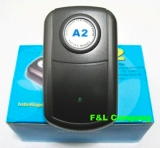
Gen Russell of Australia sent me an "A2 Intelligent Every Saver". Supposedly you just plug it in and save "up to 35%". So I turned on every light (fluorescents), the window AC units, the microwave oven, and cranked up the refrigerator. I went outside and clocked the electric meter to see how fast it was spinning. Then I went inside, plugged the A2 device into the wall, and went back outside to clock the meter again. No change. Let me repeat that: No change. Meaning I showed zero savings with this device plugged in.
The instructions for the device didn't say whether it had to be on the same circuit as the appliances, implying that any circuit was fine, but just in case, I plugged it into several different circuits. No difference, no savings.
Some years ago I bought a similar device from Home Depot called "EnergySmart PowerPlanner", which claimed to save up to 23% on my refrigerator's use, but which in my tests failed to save any energy at all. Later the CPSC issued a recall on many of these models for safety issues. Eventually the company went out of business.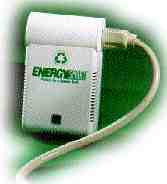 When
I heard about this device I repeatedly wrote to them asking
for a unit to test, but I never heard back from them. Maybe
they knew it didn't really work. So I finally just went out
and bought one but couldn't measure any savings even when
testing it on an ancient Whirlpool refrigerator. The device
should have worked well since older fridges are much less
efficient than newer ones. After 100 hours each with and
without, the fridge actually used 9.6% more
electricity when the device was installed. Looking at just how
many watts the fridge is pulling when the compressor is
running, the device dropped the load from 195 watts to 189 --
about a 3% reduction. Apparently the compressor had to run
longer, which is why I used more electricity overall. Even if
the compressor doesn't run longer, a 3% savings on a modern
fridge would be about 15 kWh a year -- or $1.50. The device
itself cost $30. EnergySmart listed the results of
"studies" on their website which purportedly proved their
product works, but they provided nearly no data on the studies
themselves (such as the age of the refrigerator that was
used), much less a the full text of the study or even a link
to the study's authors. Chuck
Wright tested the PowerPlanner and also failed to
realize any meaningful savings. Like most magic
"plug-it-in-and-save" devices, this product seems like more
hype than benefit.
When
I heard about this device I repeatedly wrote to them asking
for a unit to test, but I never heard back from them. Maybe
they knew it didn't really work. So I finally just went out
and bought one but couldn't measure any savings even when
testing it on an ancient Whirlpool refrigerator. The device
should have worked well since older fridges are much less
efficient than newer ones. After 100 hours each with and
without, the fridge actually used 9.6% more
electricity when the device was installed. Looking at just how
many watts the fridge is pulling when the compressor is
running, the device dropped the load from 195 watts to 189 --
about a 3% reduction. Apparently the compressor had to run
longer, which is why I used more electricity overall. Even if
the compressor doesn't run longer, a 3% savings on a modern
fridge would be about 15 kWh a year -- or $1.50. The device
itself cost $30. EnergySmart listed the results of
"studies" on their website which purportedly proved their
product works, but they provided nearly no data on the studies
themselves (such as the age of the refrigerator that was
used), much less a the full text of the study or even a link
to the study's authors. Chuck
Wright tested the PowerPlanner and also failed to
realize any meaningful savings. Like most magic
"plug-it-in-and-save" devices, this product seems like more
hype than benefit.
Devices that claim to save energy by reducing surges also don't save squat. In short,
I know of NO device that will save household energy overall simply by plugging it in or installing it at the panel.
I'm certainly willing to revise my opinion if I can measure savings in a hands-on test, but until then, my position is that if you want to save energy, you do it the obvious way: use less.