


| Gas vs. Electric Cooking calculator | ||
| Cost of fuel | Gas: $ / therm Electricity: $ / kWh | |
| Oven use ? | ||
| Stove burners |
/day
/day /day /day |
|
| Cost per year (oven + burners) |
Gas Range |
Electric Range
|
Natural Gas vs. Electric appliances
Last update: February 2015
Natural gas is almost always cheaper than electricity.
Your situation might be different depending upon local and current
prices, though. To do an accurate comparison, you'll need to
check your bills to find the rates for electric and gas that you're
paying to your particular providers. There's no way around
this; you can't get meaningful results if you skip that step.
Also, if you don't already have
gas service, then signing up for it means that you'll pay ~$20/mo.
or so to the gas company for the privilege of being their
customer. You're also looking at the cost of having
the gas lines run if your home doesn't already have them.
These things can quickly erase the savings of gas appliances over
electric in many to most situations.
While gas is generally cheaper, it
does have a couple of downsides. With gas your house
is more
likely to explode. And the byproducts of gas combustion
from ovens and heating are unhealthy to breathe, and can actually
kill pet birds. For these reasons, I use electric instead of
gas in my own home. Of course, my energy use is so small that
the extra cost of electricity is minimal for me. Likewise, I
hope to help my readers reduce their energy consumption so that the
difference between electric and gas costs for them is insignificant.
Whether electricity is greener than gas depends on how the electricity is generated. If the electricity comes from gas-fired generators, it's about the same as using gas directly. If it comes from coal-fired plants, electricity is worse. If it comes from solar, wind, or hydrothermal, electricity is cleaner.
| Laundry Costs Calculator | ||
| Case A | Case B | |
| Your machines | ||
| Washer Type |
|
|
| % of washes in Hot/Warm/Cold ? |
||
| "Cold" wash temp ? | ||
| Incoming water temp. (see map) |
||
| Water heater type | ||
| Dryer Type | ||
| Utility rates |
||
| Cost of electricity (per kWh) |
||
| Cost of gas ($/therm) | ||
| Cost of water ($/1000 gallons) |
||
| Cost of Detergent make your own for 2¢/load |
||
| Loads per week | ||
| Cost per load, washer | ||
| Cost per load, dryer | ||
| Total cost per load | $ | $ |
| Cost per month | $ | $ |
| Cost per year | $ | $ |
|
Some assumptions: 106°F hot, 88°F warm, regulated by washer. Washers are U.S. style (w/both hot & cold supply lines). See other assumptions & sources. |
||
Electric vs. gas ovens/stoves
See the calculator above. More info is available in full report on energy used by cooking.
Electric vs. gas clothes dryers
See the calculator at right. More info is available in my full report on energy used by clothes dryers.
Electric vs. gas heat
I don't have comparison tables for electric vs. gas heat specifically yet, but I do have quite a bit of info about saving energy on heating.
Cost of Natural Gas
Natural gas prices are all over the map, literaly.
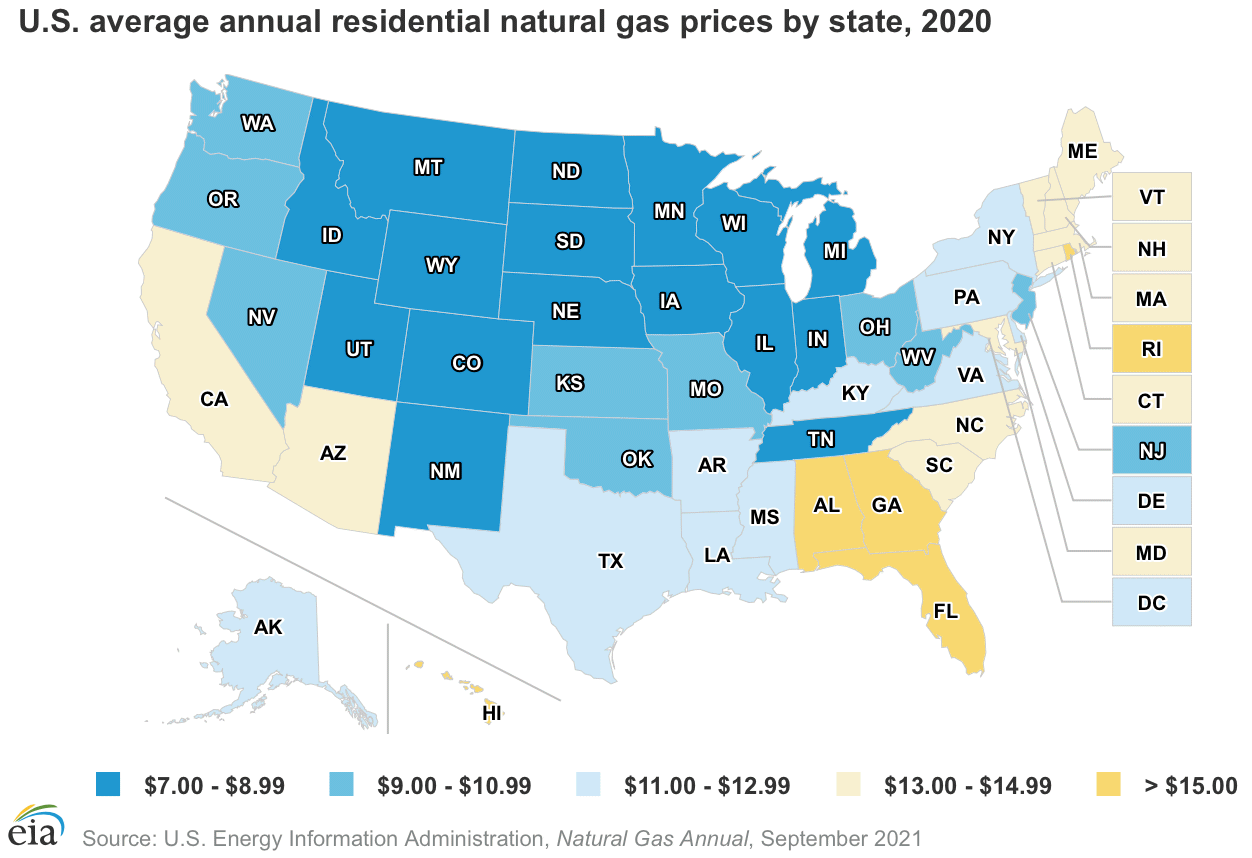
First of all, prices vary greatly by region. The price in
Florida is double the price in California. Prices have also
jumped wildly in short periods of time. The average U.S. price
doubled from 2005 to 2008, and then fell by half from 2008 to
2011. (The chart at right shows prices for the last few
decades.) Still, even when gas prices are at their highest,
it's generally cheaper to run appliances on natural gas instead of
electricity.
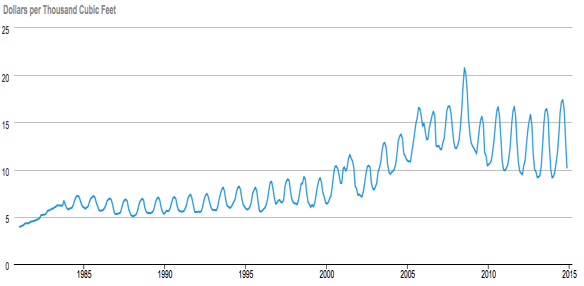
Chart from DoE. Divide price by 10 to get price per therm or per CCF.
The national average price of residential gas was $1.29/Ccf in
2014. (source)
(Ccf and therms are roughly the same, more on this later.) But
average prices are useless for calculating your own costs and
savings potential since costs vary widely by area and because they
can change quickly. That goes for state-by-state averages too,
because the price from your own provider likely differs at least
somewhat from the state average. (prices
by state)
On this site I have to use something for calculations and
defaults, so I often use $1.30/therm or Ccf, which is close to the
2014 average.
Natural gas is measured in Ccf or therms. For
calculation purposes, they're essentially the same (1 ccf = 1
therm). There's no direct conversion because ccf measures the
volume of gas, while therms measures the energy in the gas, and the
amount of energy varies by the quality of gas. It's like
trying to state how many calories are in a loaf of bread—it depends
on the bread. In the U.S. in 2013, the average was 1 therm =
1.025 ccf. (source)
That's so close that for most purposes, therms and ccf are
essentially interchangeable. Based on the above:
- Ccf = hundred cubic feet. The "C" is roman for one
hundred. Ccf ÷ 1.025 = therms.
- Mcf = thousand cubic feet. The "M" is roman for one thousand, not an abbreviation for million. Mcf ÷ 10 = Ccf. Mcf ÷ 10.25 = therms.
- Therm = 100,000 Btu. therms x 1.025 = ccf.
Therms x 100,000 = Btu.
- Btu = British thermal unit. Btus ÷ 100,000 = therms.
Some gas bills measure the gas in cubic meters instead of therms. One therm is 2.75 cubic meters, and 1 cubic meter is 0.36 therms.
Cost of Electricity
The average cost of residential electricity was 13¢/kWh
in the U.S. in 2014, though as I explain elsewhere, average
rates are all but useless for figuring how much you pay for
electricity. The average U.S. household used 909 kWh/mo. in
2013 and would pay $118.17 for it at the 13¢/kWh average rate. (Dept.
of Energy) Like gas, the
cost of electricity varies by location. Don't assume the state rates
are accurate for you, because rates vary even within a state.
I have more info about electric costs on our cost of electricity page.
|
Appliance |
|
per hour |
| Furnace pilot light | 7.3/mo. | n/a |
| Water Heater pilot light | 3.3-4.2/mo. |
n/a |
|
Range pilot light |
2.6/mo. |
|
|
Range burner, small |
0.05/hr. |
|
|
Range burner, large |
0.09/hr. |
|
|
Oven |
0.25/hr. |
|
|
Clothes Dryer |
0.19-0.35/hr. |
|
|
Furnace & water heater
pilots from Murphy
and from the discussion on this page. |
||
Comparing the operating cost of electric vs. gas appliances
Above I provide calculators for comparing the cost of gas and electric appliances. For those who prefer to crunch the numbers themselves, here's what you'll need to know:
- The price of electricity in kWh.
- The amount of electricity used in kWh.
- The price of gas in therms.
- The amount of gas used in therms.
#1 and #3 are easy to find, just look at your bill. For electricity, make sure you add all the kWh costs for electricity, since some utility companies have separate charges for delivery and fuel. (More on electrical charges.)
#2 is also pretty easy, using the tables and methods described on this site. For starters, here's our page of electricity used by typical appliances, and how to measure electrical use.
#4 is usually the hardest, because the amount of gas used by
appliances for a given task or amount of time is usually not so easy
to find. But I'll make it easy by listing those figures for you now,
and throw in the electric version for comparison, in the table at
right.
Gas used by the pilot light
The gas used by pilot lights is substantial. At $1.40/therm, you're looking at $183/yr. to run the pilots in a furnace and a water heater, not even counting a stove. Pilots could easily account for over 70% of summer gas usage, and 40% of total usage. (Murphy)
If your furnace has a pilot, turn it off during the non-heating months. (You can't just blow it out, because gas will still flow, and soon your house will blow up.) For your stove, turn off the burner pilots and use a click-lighter to light them. And the next time you replace your appliances, get the ones that have electric ignition.
In the winter, the energy from the pilot lights isn't wasted since it adds heat to your home. But when you're not running a heater, then pilot lights are 100% wasteful.
While Murphy's pilot light article gives 3.3 therms/mo. for a water heater pilot light, his water heating page suggests 4.2 therms, as follows:
- 510 Btu per meter revolution, with ten revolutions in 11.2 hours. That's one revolution every 10÷11.2 = 0.893h.
- At 30.4375 days in a month times 24 hours/d, that's 730.5 h/mo. So 730.5 h/mo. ÷ 0.893 h/rev = 818 revs/mo.
- That's 818 revs./mo. x 510 Btu/rev = 417,180 Btu/mo..
- At 1 therm = 100,000 BTU, 417,180 Btu ÷ 100,000 = 4.17 therms.