
Scientific Research on
Vegetarian/Vegan Diets, Protein, etc.
There have been hundreds of studies on the medical journals on vegetarian or near-vegetarian diets, almost all of which show positive outcomes. I don't have time to list even a fraction of them here, but I'll list some as I come across them.
In general. A review covering 50 studies over 23 years concluded, "Vegetarian and vegan diets are significantly associated with better lipid profile, glycemic control, body weight/BMI, inflammation, and lower risk of ischemic heart disease and cancer. Vegetarian diet is also associated with lower mortality from CVDs." (2024)
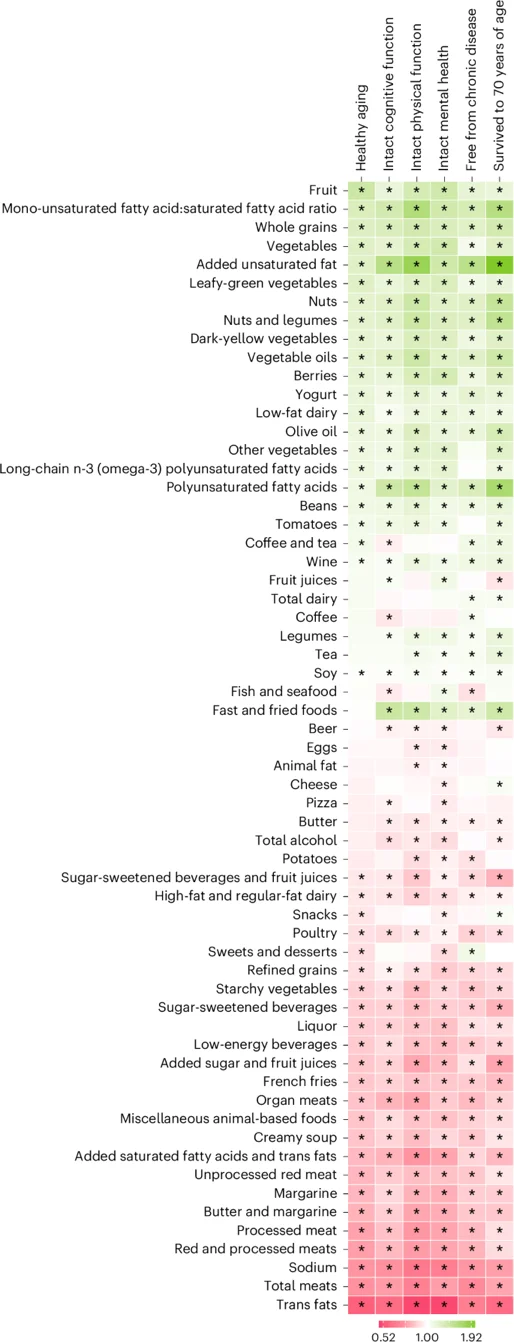
Foods ranked. A study of thousands of subjects over 30 years shows which foods were associated with better health or worse health. Not surprisingly, animal foods are clustered near the bottom while plant foods are clustered near the top. (Nature Medicine 2025)
Aging. One problem with vegetarian
studies is the cofounding variables, such as that vegetarians
are more likely to eat healthier in general (less sugar, less
processed foods) than meat-eaters. As a related example,
for decades people went to Dr. McDougall's clinic, he took
them off all animal foods and all processed foods,
then he credited the result to just the elimination of animal
foods. Another problem with many studies is being blind
to what factors are influenced by genetics. So, one
study got around both problems by feeding one group a vegan
diet and another a "healthy" omnivorous diet, and by studying
twins (genetically identical), having the twins each do a
different diet. After just eight weeks, "the researchers
found that the participants who followed the vegan diet saw a
significant reduction in markers of overall biological aging,
including specific age-related markers in the heart, liver,
hormone, inflammatory, and metabolic systems." (Prevention,
BMC
Medicine, 2024)
Baby development. Vegan, vegetarian, and
omnivorous babies developed at similar rates by age two. (JAMA
2026)
Blood Pressure. Vegetarians and vegans
had lower blood pressure than non-vegetarians. (Public
Health Nutr, 2012)
BMI. Vegetarians and vegans had lower BMI (body mass index, a marker for overweight) than non-vegetarians. (Public Health Nutr, 2012)
Cancer
- General, Various.
- The more red meat (processed and unprocessed) consumed, the greater the risk of dying from heart disease or cancer. One serving of processed meat (hot dogs, bacon, etc.) per day was associated with a 21% higher risk of death from heart disease and 16% higher risk of death from cancer. (Arch Intern Med, 2012)
- Vegetarians had lower rates of bladder cancer and of cancers like non-Hodgkin's lymphoma and multiple myeloma. (British Journal of Cancer, 2009)
- Breast cancer. Vegetarian women are expected to have a lower risk of breast cancer, since they experience menopause at an earlier age, and older age at menopause is associated with a higher risk of breast cancer. (Am J Epidemiol, 2012)
- Myeloma. High fiber, plant-based diet shown to delay the progression of multiple myeloma, an incurable blood cancer. (Am. Soc. Hematology, 2024)
Cell aging. In the group of 10 men who switched to a vegetarian diet and stuck to a recommended timetable of exercise and stress-busting meditation and yoga, telomere length increased significantly by an average of 10%. In comparison, telomere length decreased by an average of 3% in the remaining 25 men who were not asked to make any lifestyle changes. (Dr. Ornish, Lancet, 9/13; BBC)
Chicken. Those eating four servings per week (300g) were twice as likely to suffer early death vs. those eating 100g/week. (Nutrients 2025)Deficiencies. A review of 141 studies spanning twenty years concluded:
| Deficiencies by Diet Type | ||||
| Vegans | Vegetarians | Meat-eaters | Higher intake in Veg*ns |
|
| Protein | ||||
| Fiber, women |
||||
| Fiber, men | ||||
| PUFA | ||||
| ALA, men | ||||
| ALA, women | ||||
| EPA+DHA | ||||
| Vitamin A | ||||
| Vitamin B1 | ||||
| Vitamin B2 | ||||
| Niacin | ||||
| Vitamin B6 | ||||
| Folate | Deficient in 38% of studies |
|||
| Vitamin B12, intake (inc. supplements) |
Avg. was sufficient, but median was insufficient |
|||
| Vitamin B12, subjects with deficient status |
4-73% | 0-75% | 0-16% | n/a |
| Vitamin C | ||||
| Vitamin D, intake | ||||
| Vitamin D, subjects with deficient status |
3-67% | 0-33% | 0-6% | n/a |
| Vitamin E | ||||
| Calcium | Deficient in 41% of studies |
Deficient in 33% of studies |
Deficient in 34% of studies |
|
| Iodine, intake | ||||
| Iodine, status | 92% deficient | 37% deficient | 51% deficient | n/a |
| Iron, intake | Deficient in 22% of studies |
|||
| Iron, subjects with deficient status |
15% | 11% | 7% | n/a |
| Iron, anemia | 17% | 11% | 5% | |
| Magnesium, men | ||||
| Magnesium, M+F | avg. intake sufficient, but deficient in 58% of studies |
|||
| Phosphorus | ||||
| Zinc, intake | ||||
| Zinc, deficient status | 30% | 14% | 13% | n/a |
|
at or above recommended level below recommended level (Nutrients 2022) |
||||
Depression. Consumption of proline has been linked to depression. It’s most abundant in animal foods such as grass-fed beef, wild-caught fish, and gelatin. (SciTechDaily 2025)
Diabetes. Meta-analysis of 20 vegetarian interventions showed an average reduction in A1C of 0.25 percentage points. (Cardiology 2023) Vegan diet promoted greater reduction in A1C than non-vegan diet. (Advances in Nutrition 2024)
Fruits and vegetables don't overcome the consequences of meat. While it’s well established that meat is correlated with early death and fruits and vegetables with longer life, what about people who eat a lot of both? Can eating lots of fruits and veggies counteract the damage of meat? Research suggests no. In a study of 70,000 men, those eating the most red/processed meat had a 21% higher risk of overall mortality (and 29% higher risk of dying from heart disease), and the risk was not affected by the amount of fruit and vegetable consumption. Among the heavy meat-eaters, the risks were similar between those who ate lots of fruits and vegetables and those who ate little. (Am J Clin Nutr, 2016)
Heart Disease.
- Study was of 22 sets of twins. One twin in each set ate a vegan diet for 8 weeks, the other didn't. The vegan subjects experienced drops in LDL-C (-15 mg/dL), fasting insulin (20%), and body weight. (Stanford, Nutrition, Obesity, & Exercise 2023)
- Meta-analysis of 20 vegetarian interventions showed an average reduction in LDL-C of 6.8 mg/dL. (Cardiology 2023)
- Animal protein associated with increased mortality, plant protein opposite (2016); see Mortality.
- The more red meat (processed and unprocessed) consumed, the greater the risk of dying from heart disease or cancer. One serving of processed meat (hot dogs, bacon, etc.) per day was associated with a 21% higher risk of death from heart disease and 16% higher risk of death from cancer. (Arch Intern Med, 2012)
Hip Fractures. While veg*ns fare better for most health metrics compared to omnivores, hip fractures were shown to be 25% higher for vegetarians and 131% higher for vegans. (BMC Med 2021) But the risk seems to be erased by supplementation: in another study, vegan women who took calcium and vitamin D supplements did not have a higher risk of hip fractures. (Am J Clin Nutr 2021)
Inflammation. Vegans had substantially lower hsCRP concentration and lymphocyte counts than vegetarians and omnivores. (Nutrients 2025)
Lifestyle reduces chronic disease. People with four healthy lifestyle factors reduce their risk of diabetes (93%), heart attack (81%), stroke (50%), and cancer (36%) compared to those with no factors. The four factors are never smoking, not being obese, being physically active (≥3.5 hours/wk), and eating fruits, vegetables, and whole grains while eating little or no red meat. (Archives of Internal Medicine, 2009)
Longevity (definition) • See also: Mortality
- Countries with higher consumption of plant foods have longer adult life expectancies. The reverse was true for those under-five-years-old mortality. (Nature Communications 2025)
- No difference in chances of reaching age 100 between vegans and non-vegans, among those who were not underweight. Underweight vegans were less likely to reach 100. Those who ate fish, dairy, or eggs were just as likely to reach 100 as meat-eaters. (Am. J Clin Nutr, 2025)
Meat. See: Cancer, Heart Disease, Mortality, Protein.
Mental Health. Vegetarians had less stress and tension than meat-eaters or fish-eaters. (Nutr J, 2012)
Milk, cow vs. soy. Meta-analysis showed that switching from cow milk to soy milk resulted in reductions of non-HDL-C, LDL-C, blood pressure, and C-Reactive Protein. (Nutrition Made Simple video, 2025)
Mortality (definition) • See also: Longevity
- Animal proteins were associated with mortality, plant proteins were the opposite. (JAHA 2021)
- High animal protein intake was associated with cardiovascular mortality, while plant protein intake was the opposite. Switching from animal to plant protein was associated with lower mortality. (JAMA Internal Medicine, 2016)
- The more red meat (processed and unprocessed) consumed, the greater the risk of dying from heart disease or cancer. One serving of processed meat (hot dogs, bacon, etc.) per day was associated with a 21% higher risk of death from heart disease and 16% higher risk of death from cancer. (Arch Intern Med, 2012)
Protein. Animal protein associated with increased mortality, plant protein opposite; see Mortality.
Red meat. See: Cancer, Heart Disease.
Ultraprocessed foods. Study conclusions:
- Only processed meats associated with an increased risk of heart disease and stroke.
- Ultraprocessed vegan foods such as savory snacks and cold cereals associated with a lower risk of heart disease.
- Higher intake of breads and cereals associated with a lower risk of stroke.
- Study didn’t examine other ultraprocessed plant foods such as fake meats. (Lancet Reg Health Am, 2024)
Another study’s conclusions, about the risk of developing two or more chronic diseases:
- Higher consumption of ultraprocessed animal-based products and artificial- and sugar-sweetened bevverages were associated with a higher risk.
- Higher consumption of ultraprocessed plant-based alternatives or ultraprocessed breads and cereals was not associated with a higher risk. (Lancet Reg Health Eur, 2023)
Weight loss. Meta-analysis of 20 vegetarian interventions averaging 6 months showed an average reduction in body weight of 7.5 lbs.. (Cardiology 2023)